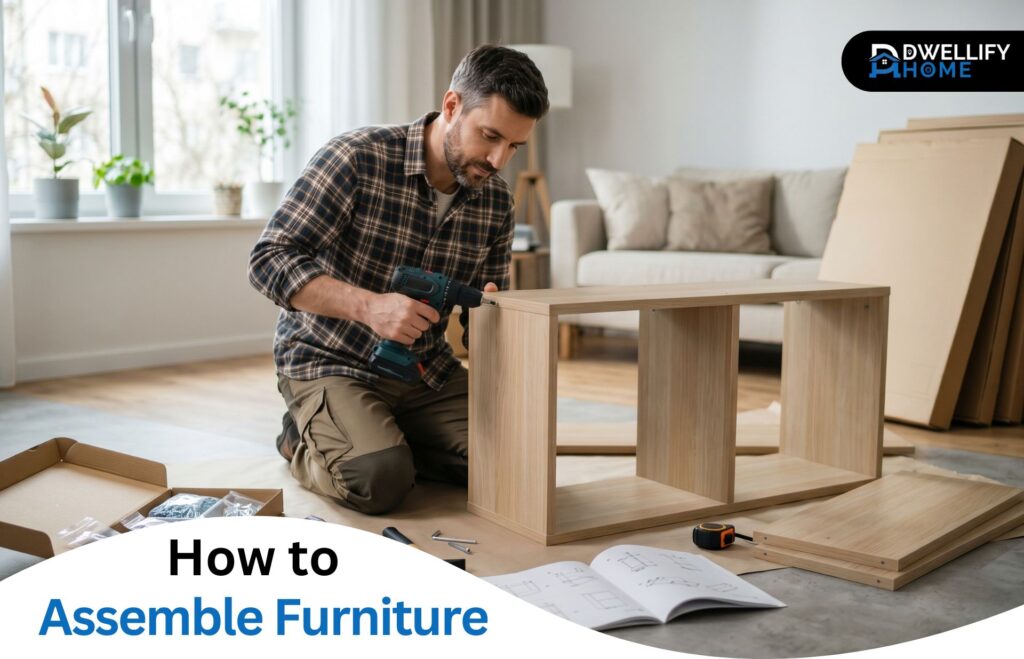
After putting together more boxed furniture than I can count — dressers, wardrobes, bunk beds, office desks, you name it — one thing has stayed true the whole time. Most assembly headaches don’t come from the furniture itself. They come from rushing the first ten minutes, skipping a tiny step on page two of the manual, or working in the wrong spot.
This guide walks through how to assemble furniture the way I’d teach a friend doing it for the first time. Real steps, real shortcuts, and the small details most people only learn the hard way.
The Short Answer
Assembling furniture is the process of putting together flat-pack or boxed pieces using included hardware, screws, dowels, and brackets. It saves money, allows easier delivery, and turns loose panels into a finished, stable piece for your home.
Mission Statement
At Dwellify Home, we help homeowners make practical, stylish, and informed décor decisions. Our guides cover modern home setups, garden and outdoor living, home solutions, and property essentials, written to give real, useful direction for everyday living spaces.
What Does Assembling Furniture Actually Mean?
Assembling furniture means putting together a piece that arrives in flat parts, with hardware and instructions included, so you can build it at home. You’ll often hear it called flat-pack furniture, ready-to-assemble (RTA) furniture, or boxed furniture. The job is always the same — connect the panels using screws, dowels, cam locks, and brackets until the loose parts become one finished piece.
Some items have five components. Others have fifty. The complexity varies, but the underlying process follows the same logic every time.
Key Benefits of Assembling Furniture Yourself
- Saves money on professional assembly fees
- Lets you build the piece directly in its final room
- Builds confidence with basic tools and DIY skills
- Gives you full control over alignment and finish quality
- Makes future moves easier since you already know how to disassemble and rebuild
Quick Tool Reference
| Tool | When You Need It |
| Phillips Screwdriver | Almost every flat-pack build |
| Allen Wrench (Hex Key) | Most IKEA and standard furniture |
| Cordless Drill (low torque) | Larger pieces, dressers, wardrobes |
| Rubber Mallet | Tapping panels and dowels into place |
| Spirit Level | Bookcases, wardrobes, and tall units |
| Tape Measure | Checking placement and fit |
Tools You Need to Assemble Furniture at Home
Most flat-pack furniture comes with a small Allen wrench in the box. Honestly, those tools are fine in a pinch, but they’re slow and the soft metal strips quickly on bigger jobs. Keeping a basic kit on hand makes everything faster and cleaner.
Here’s what I reach for on almost every build:
- A full-size Phillips screwdriver (not the mini one in the bag)
- A metric Allen wrench / hex key set
- A cordless drill with adjustable torque
- A rubber mallet for tapping panels into place
- A tape measure and a small spirit level
- A box cutter
A cordless drill saves serious time on larger pieces, but use a low torque setting. High torque is the number one reason people strip screws.
Understanding the Hardware Inside the Box
Open any flat-pack box and you’ll see a small bag full of unfamiliar-looking pieces. Knowing what each one does removes most of the confusion before you start.
- Screws and bolts hold the main panels together. The longest ones usually go through the thickest sections.
- Wooden dowels are smooth pegs that fit into pre-drilled holes to align panels. A drop of wood glue inside the hole makes them sit firmly for years.
- Cam locks (sometimes called minifix cams) are round metal discs that lock with a clockwise turn. The arrow on top should point toward the incoming bolt.
- Brackets and corner braces add structural support for shelves, frames, and load-bearing joints. When you’re learning how to assemble furniture with brackets, the key is making sure each one sits perfectly flush before you tighten the screws.
- Hinges attach doors and almost always need fine adjustment after fitting.
Sort all of these into small containers or a magnetic tray before you start. It’s a five-minute habit that saves twenty minutes of hunting on the carpet later.
Setting Up Your Workspace the Right Way
Build your furniture in the room where it will actually live. Moving a fully assembled wardrobe through a doorway is a problem you don’t want to discover at the end.
Lay down the flattened cardboard box or a soft blanket as a working surface. This protects both the panels and your floor. Keep the area well-lit, give yourself enough space to spread every piece out, and make sure you can walk around the build without bumping into anything.
Step-by-Step Guide: How to Assemble Furniture From Start to Finish
Step 1 — Open the Box Carefully and Sort Every Part
Use a box cutter to slice along the seams, not deep into the box. Many panels sit right against the cardboard, and a deep cut leaves a permanent scratch on the finished side.
Step 2 — Read the Full Instruction Manual Before You Begin
Skim every page first. You’re looking at how the piece comes together — orientation, sequence, and which side faces out. Five minutes of reading saves an hour of taking things apart later.
Step 3 — Lay Out Pieces in the Order of Assembly
Match every panel and hardware bag to the parts list in the manual. If something’s missing or damaged, contact the manufacturer before you start, not after you’ve half-built it.
Step 4 — Start With the Frame or Largest Components
The base, sides, or main frame usually goes first. These pieces become your reference points, and everything else builds off them.
Step 5 — Connect Parts Using the Correct Hardware
Match each hardware type to the right step. Dowels go in first, then cam bolts, then any brackets or screws. When working with screws, start them by hand to feel the thread catching, then finish with a screwdriver or drill on a low setting.
Step 6 — Keep Fasteners Slightly Loose Until Everything Is Aligned
This is the single biggest tip I can give a beginner. Don’t fully tighten anything until the entire piece is together. Loose fasteners give you the wiggle room to square the frame properly.
Step 7 — Tighten Everything Once the Piece Is Square
Once the structure looks aligned, work back through and tighten each fastener firmly. Stop the moment you feel real resistance. Going further strips the hole and weakens the joint.
Step 8 — Test for Stability and Make Final Adjustments
Gently rock the piece. If a leg lifts or a panel flexes, find the loose fastener. Adjust hinges and drawer slides last so doors hang flush and drawers slide smoothly.
Pro Tips That Make Furniture Assembly Faster and Cleaner
A few habits picked up over the years that genuinely save time:
- Take a quick photo of every hardware bag before opening it. If a piece goes missing later, you know exactly what to ask the manufacturer for.
- Add a drop of wood glue inside dowel holes for long-term stability, especially on dressers and bookcases.
- For larger pieces, work with a partner. One person aligns, the other fastens.
- Cut the short end off a spare Allen wrench and chuck the long end into your drill. It speeds up cam bolts dramatically.
Common Furniture Assembly Mistakes to Avoid
The same mistakes show up over and over on first builds:
- Skipping the instructions and trying to wing it
- Over-tightening screws and stripping the threads
- Mixing up similar-looking panels (left side vs. right side)
- Hammering dowels in too hard and splitting the wood
- Ignoring the small directional arrows on cam locks
- Tightening every screw fully as you go, instead of leaving them loose
Each one of these forces a rebuild. Slow down at the start and you avoid all of them.
Troubleshooting: What to Do When Something Goes Wrong
Misaligned or Wobbly Pieces
Check the floor first. An uneven surface can make a perfectly built piece feel wobbly. If the floor is level, loosen all fasteners on the frame, square the piece by eye, and re-tighten in sequence.
Stripped Screws or Damaged Holes
For a stripped screw hole in particle board, push a couple of wooden toothpicks dipped in wood glue into the hole, snap them off flush, let it dry, then re-drive the screw. It holds remarkably well and saves the panel.
Missing or Damaged Parts From the Manufacturer
Contact the seller before doing anything else. Most reputable retailers ship replacement hardware free within a few business days. Don’t substitute random screws from your own toolbox — wrong sizes damage the pre-drilled holes.
Safety First: Anchoring Tall Furniture to Prevent Tip-Overs
Any piece taller than it is wide — wardrobes, bookcases, tall dressers — needs to be anchored to the wall. Tip-over kits come included with most modern furniture, and they’re not optional in homes with kids or pets.
Use the included strap or bracket, drive the wall screw into a stud where possible, or use a proper drywall anchor. This single step prevents the most serious furniture-related injuries at home.
Finishing Touches: Final Placement, Cleanup, and Long-Term Care
Once the piece is built, snap the small plastic caps over visible cam locks for a clean finish. Adjust hinges so doors sit flush — most cabinet hinges have two or three small screws for height, depth, and side-to-side alignment.
Recycle the cardboard, bag up the packing materials, and wipe the piece down. A month or two later, give every fastener a quick re-tighten. Wood expands and contracts with temperature, and a 30-second check keeps everything solid for years.
Tips for Assembling Different Types of Furniture
Beds and bed frames — Build directly in the bedroom. Keep the center support beam tight; it’s what stops the mattress from sagging over time.
Wardrobes and tall cabinets — Always a two-person job. Build the frame on its back, stand it up against the wall, then add doors and shelves.
Dressers and chests of drawers — Drawers go in with the runner wheels facing the back. Use a rubber mallet, never a hammer, for any tight runner joints.
Desks, tables, and chairs — Flip the tabletop upside-down on a soft surface, attach the legs and supports, then turn it right-side up. Saves your back and stops scratches.
Bookcases and shelving units — Build flat on the floor and stand it up only after every shelf and the back panel are fixed in place.
Brand-Specific Notes for IKEA, Wayfair, Amazon, and Other Flat-Pack Furniture
IKEA is consistent. Manuals are picture-based, hardware is well-labeled, and the tolerances are tight. The included Allen key is slow though, so bring your own.
Wayfair quality varies a lot depending on the manufacturer behind the listing. Check the parts list carefully before starting; missing hardware is more common here.
Amazon flat-pack pieces, especially budget brands, often have looser tolerances. Pre-drilled holes don’t always line up perfectly, so leave fasteners loose for longer than usual.
Pottery Barn, West Elm, and Crate & Barrel generally use better hardware and clearer instructions, so assembly tends to be faster and cleaner.
How Long Does Furniture Assembly Usually Take?
Most flat-pack furniture takes between 30 minutes and 4 hours depending on the size and complexity. A simple side table or chair takes around 30 minutes. A dresser or TV stand runs roughly 1 to 2 hours. Wardrobes, large desks, and bunk beds usually need 3 to 4 hours, often with a second pair of hands.
Plan for slightly longer than the box says. The times printed on packaging assume zero mistakes — and there are always one or two.
DIY or Hire a Pro? How to Decide What’s Right for You
DIY makes sense when the piece is small to medium-sized, you have spare time, and you’re comfortable using basic tools. You save money and gain real confidence with each build.
Bringing in a professional makes more sense when the piece is heavy or oversized, the manual is genuinely complex, you’re short on time, or you have physical limitations that make the work painful. Costs vary by region, but for a complicated wardrobe or bunk bed, the time and stress saved often justifies the spend.
Frequently Asked Questions About Assembling Furniture
Do you need special tools to assemble furniture?
Most flat-pack furniture only requires a Phillips screwdriver and an Allen wrench, both of which usually come in the box. For larger or more complex pieces, a cordless drill, rubber mallet, and spirit level make the work faster and more accurate. Specialty tools are rarely needed for standard home furniture.
Can one person assemble heavy furniture alone?
One person can assemble most flat-pack furniture, including dressers and small bookcases. Anything tall, wide, or weighing more than around 70 pounds — wardrobes, bunk beds, large wall units — is safer and faster with two people. Solo assembly of heavy items risks injury and damage during the lifting stages.
What should I do with leftover screws or hardware?
Manufacturers usually include a few spare screws, dowels, and cam locks. Keep them. Store the leftovers in a labeled bag along with the instruction manual. If a fastener loosens or strips months later, having the exact replacement saves a trip to the store and a guessing game.
Is it okay to use a power drill on flat-pack furniture?
A cordless drill is absolutely fine and often recommended, but always use a low torque setting. High torque strips screws and damages particle board quickly. Start each screw by hand to catch the thread, then finish with the drill on its lowest setting and stop the moment the screw sits flush.
What if a part is damaged or missing from the box?
Contact the retailer or manufacturer before starting the build. Most companies ship replacement parts free within a few business days. Don’t substitute hardware from your own toolbox — incorrect sizes damage the pre-drilled holes and may void the warranty on the piece.
Final Thoughts: Assemble Furniture With Confidence
The biggest factor in a smooth build isn’t skill — it’s patience. Read the manual, sort your hardware, work on a soft surface, and leave the fasteners loose until the end. That’s the whole formula. Once you’ve followed these steps on a few pieces, knowing how to assemble furniture starts to feel like second nature, and the next dresser or bookcase becomes a single-coffee job rather than a ruined afternoon.
Disclaimer
This article is for general informational purposes only. Individual furniture types, hardware, manufacturer instructions, and home conditions vary, so results may differ from one situation to another. Always follow the official assembly manual that comes with your furniture, and consider professional help for complex or oversized items.