
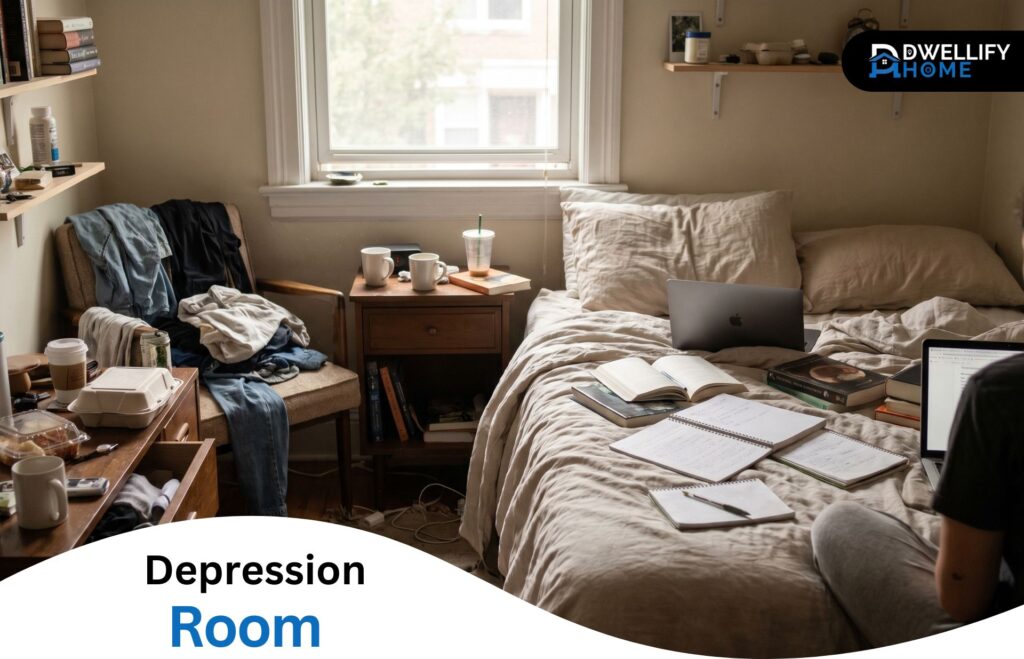
There’s a moment many people describe the same way. They’re standing in the doorway of their bedroom, looking at a space that has slowly stopped feeling like a room and started feeling like evidence. Laundry in shapes. Dishes on the nightstand. A floor that’s more suggestion than surface. They know they should clean it. They want to clean it. And yet nothing moves.
That moment has a name now: the depression room.
Snippet-Ready Definition
A depression room is a living space — usually a bedroom — that becomes severely cluttered or neglected due to depression. It reflects mental and physical exhaustion, not laziness, and often deepens the depressive cycle by increasing stress and shame.
Mission Statement
At Dwellify Home, we help homeowners create spaces that work for real life — not just the highlight reel. From practical home solutions to thoughtful room design, our goal is to give you clear, honest guidance that makes your home feel more like yours. We cover modern living, home wellness, outdoor spaces, and everything in between.
What Is a Depression Room?
A depression room is a living space — most often a bedroom — that has become severely cluttered or neglected as a direct result of depression. It is not the result of laziness or poor character. It reflects mental and physical exhaustion so deep that even basic self-care tasks like tidying up feel genuinely impossible.
How the Term Became Part of the Cultural Conversation
The phrase first gained traction on TikTok and YouTube, where creators began filming their own neglected spaces and walking viewers through the process of cleaning them. These videos accumulated hundreds of millions of views — not because the content was entertaining, but because it was honest. People finally saw their own rooms reflected back at them without judgment.
What the trend did, more than anything else, was remove the secrecy. It put a name to something that had quietly existed in homes everywhere, and it made it easier to say out loud.
What a Depression Room Actually Looks Like
A depression room isn’t just a messy room. It’s typically a space where multiple systems have broken down at the same time. Clothes cover most of the floor — some clean, some not, with no real distinction anymore. Empty cups and plates accumulate on the nightstand and desk. Trash sits near the bin but not in it. Surfaces are buried. Natural light might be blocked.
What makes it recognizable is the layer of it — not one bad day, but many weeks compressed into a single room.
A Depression Room Is Not the Same as Just Being Messy
This distinction matters. Everyone has periods where their space gets untidy — a busy week, a move, a sick child, a deadline. That’s normal life. A depression room is different. It represents a change from how the person would normally live, and it causes distress. The person doesn’t feel comfortable in it; they feel trapped by it.
If a messy home is a preference or a temporary side effect of a full life, that’s one thing. If it’s a source of shame and feels completely beyond your control, that’s something worth paying attention to.
Key Points at a Glance
- A depression room forms when depression drains the energy, motivation, and focus needed for basic upkeep
- The mess and depression create a feedback loop — each one makes the other worse
- Starting with just one category (trash, dishes, laundry) is more effective than attempting a full clean
- People with ADHD or executive dysfunction are especially prone to depression rooms and doom piles
- Addressing the mental health condition alongside the space produces more lasting results than cleaning alone
Why Depression Makes Cleaning Feel Impossible
Depression depletes the brain chemicals responsible for energy, motivation, and reward. Cleaning requires all three. When dopamine, serotonin, and norepinephrine are suppressed, even small tasks like picking up a cup feel disproportionately difficult — not because of willpower, but because of neurology.
The Role of Fatigue — When Your Body Has Nothing Left
Depression fatigue isn’t the same as being tired after a long day. It’s a heaviness that doesn’t lift after sleep. Some people sleep ten or twelve hours and still wake up feeling like they’ve been carrying something heavy all night. Physical movement — even standing up — can feel like too much to ask.
When that’s the baseline, the idea of cleaning an entire room doesn’t just feel hard. It feels physically out of reach.
How Depression Disrupts the Brain’s Reward System
The brain’s reward system relies heavily on dopamine. When you complete a task, dopamine signals a sense of accomplishment — a quiet but real feeling of “that was worth doing.” In depression, that signal is weakened or absent entirely. You can clean the entire room and feel nothing from it.
This is why people with depression often say “what’s the point?” — not because they don’t care, but because their brain genuinely isn’t generating the reward that makes effort feel worthwhile.
Brain Fog and Decision Paralysis
Stand in a cluttered room and your brain immediately starts cataloguing what needs to happen. Pick that up. Move that. Sort this. Where does that go? The cognitive load is significant even in a healthy brain. In a depressed brain already running on reduced capacity, that same room can cause a complete shutdown.
This is what’s often called brain fog — the inability to think clearly or prioritize. It’s not laziness. It’s the mental equivalent of trying to run a complex program on a device with almost no available memory.
This Is a Symptom — Not a Character Flaw
A depression room is a symptom of illness, not evidence of who you are as a person. Struggling to maintain a clean space during a depressive episode is as logical as struggling to walk on a broken leg. The room reflects what your brain is going through — nothing more, nothing less.
Does a Messy Room Make Depression Worse?
Yes — research suggests the relationship runs both ways. Depression leads to clutter, and clutter actively worsens depression. A disorganized environment raises cortisol levels, reduces cognitive clarity, and creates a constant low-level sense of overwhelm that reinforces hopelessness and low mood.
What the Research Actually Shows
A 2020 study published in BMC Public Health found that higher levels of household disorganization were linked to worse cognitive, behavioral, and emotional outcomes in both children and adults. UCLA researchers have separately documented a connection between cluttered homes and elevated cortisol — the body’s primary stress hormone. Chronically elevated cortisol is associated with worsened anxiety, mood disruption, and reduced ability to cope.
A 2016 study also found a meaningful link between clutter and reduced wellbeing, independent of hoarding behavior. The evidence consistently points to the same conclusion: our physical environments influence our mental state in ways most people underestimate.
The Cycle That Keeps People Stuck
The cycle typically goes like this: depression reduces the energy to clean. The mess accumulates. Looking at the mess generates shame and overwhelm. Shame deepens the depression. The depression reduces energy further. The room gets worse.
Each stage reinforces the next. By the time someone is deep in this cycle, the room itself has become part of the illness — not just a consequence of it.
Depression Rooms, ADHD, and Doom Piles
People with ADHD or other executive functioning challenges are especially vulnerable to depression rooms. Decision fatigue makes it hard to know where to put things, so items pile up in what’s become known as “doom piles” — collections of objects that have no assigned home and feel too overwhelming to address.
What Doom Piles Are and Why They Form
A doom pile is a cluster of miscellaneous items that have been set down in the same spot repeatedly because making a decision about each one felt too hard in the moment. It might include mail, chargers, receipts, clothes, books, and random objects with no obvious category.
For someone with ADHD, object permanence also plays a role — if something is out of sight, it genuinely stops existing in the mind. So things stay out, and the pile grows.
Why Standard Cleaning Advice Doesn’t Work for Everyone
“Just put things back where they belong” assumes everything has a place. For someone with executive dysfunction, many items genuinely don’t have an assigned home — and deciding where that home should be is its own overwhelming task. Standard organizing advice skips entirely over the decision-making burden, which is often the real barrier.
The Shame That Makes It Harder to Start
Why Your Space Feels Like a Reflection of Your Worth
There’s something about a cluttered room that feels deeply personal in a way a cluttered office rarely does. A bedroom is intimate. It’s where you start and end every day. When it’s in disarray, many people begin to feel that the room is a verdict on them — proof that they’re failing at something fundamental.
This is compounded by social comparison. Clean, organized spaces are constantly shown as the standard. When your reality looks nothing like that, the gap between what is and what “should be” becomes its own source of pain.
Releasing the Guilt Before You Touch Anything
Before any cleaning strategy works, the guilt has to loosen its grip. Not disappear — just loosen. The most useful reframe is this: your space reflects a period of illness, not your identity. The room is not who you are. It’s what happened while you were struggling to survive something hard.
Giving yourself that acknowledgment isn’t weakness. It’s actually what makes forward movement possible.
Shifting from “I Have to Fix This” to “I Can Start Anywhere”
Perfection is the enemy of any progress here. The goal isn’t a magazine-worthy room. The goal is a space that’s slightly safer, slightly more functional than it was an hour ago. That shift — from “fix everything” to “do one small thing” — is what actually gets people moving.
Function first. Aesthetics later. Always.
How to Clean a Depression Room When You Have No Energy
Start by dividing the room into just five categories: trash, dishes, laundry, things that have a home, and things that don’t. Work through them one at a time, in any order you can manage. The goal is not a clean room — it is a safer, slightly more functional one. That is enough.
Step 1 — Remove the Trash First
Grab a garbage bag and do one pass around the room collecting only obvious trash. Wrappers, tissues, empty bottles, food packaging. Don’t sort. Don’t organize. Just remove anything that is clearly waste.
This step produces the fastest visible change with the least cognitive effort, which is exactly why it belongs first.
Step 2 — Gather the Dishes (Moving Them Is Enough)
Collect every cup, plate, or utensil and move them to the kitchen or the sink. You don’t have to wash them. Getting them out of the bedroom and into the right room is the entire goal of this step. Sanitation matters; sparkling dishes do not.
Step 3 — Deal With the Laundry One Pile at a Time
The goal here is a hamper or a single, designated pile — not folded drawers. Dirty laundry together. Clean laundry together. Folding is optional and can wait. Laundry often feels harder than it is because we attach too many steps to it at once.
Step 4 — Return Things That Have a Home
Walk around the room with a laundry basket or bag and collect items that belong in other rooms. Hairbrush to the bathroom. Book to the shelf. Phone charger to the desk. One trip per room if you can manage it.
Step 5 — Contain What Doesn’t Have a Home Yet
For everything that remains and has no obvious place, put it into a single bin or basket. Label it “to sort.” Leave it for another day. This removes the decision fatigue of figuring out where things go while you’re already running low on energy.
Practical Strategies for Cleaning With Low Energy
The 5-Minute Timer Method
Set a timer for five minutes and give yourself full permission to stop when it goes off. Do whatever you can in that time without any pressure to finish. The permission to stop is what makes starting feel possible — and more often than not, the momentum continues past the timer.
Clean One Section, Not the Whole Room
Don’t try to address the room as a whole. Stand at one corner, or start at the bed, and work only within that small zone. Once that area is clear, it gives your brain a visual rest point — a spot where things are better. That matters more than it sounds.
Make It Feel Less Like a Task
Pair the cleaning with something comforting. A familiar podcast, an audiobook, background TV you’ve seen before. Ambient stimulation helps depressed brains stay engaged with an unpleasant task without having to fight for focus the entire time.
Ask Someone to Be There With You
Body doubling — having another person present while you work — is well-documented as effective for people with ADHD and depression alike. They don’t need to help. Just being in the room with someone can make the task feel less isolating and more achievable.
Asking for that isn’t a sign of weakness. It’s a practical strategy.
When to Call in a Professional Cleaner
Some situations genuinely call for outside help. Physical limitations, childcare demands, a severe depressive episode, or a room that has reached a point where one person can’t realistically tackle it alone — all of these are valid reasons to bring in a professional cleaner or organizer. There’s no shame in it. Getting the room to a manageable starting point is sometimes the best first step toward taking over yourself.
How to Stop the Depression Room From Coming Back
Build Systems, Not Habits
Habits depend on motivation and consistency, which are both unreliable during periods of low mental health. Systems don’t. A system removes the need to decide — the bin is already there, the hook is already there, the path to put something away is already obvious and easy. Design the room so maintenance takes the least possible effort.
Design Your Space to Require Less Decision-Making
Friction is the enemy of a functional room. If putting something away requires opening a drawer, moving something else, and finding the right spot, it won’t happen consistently. Open bins, visible shelving, and designated surfaces for high-use items dramatically reduce the daily effort of keeping things in order.
The less your room asks of you, the more likely you are to meet that ask.
Small Environmental Changes That Support Mental Health Daily
Small changes to a room’s environment can have a genuine effect on mood. Keeping one clear surface — even just a desk or a nightstand — gives the brain somewhere visually calm to land. Letting in natural light, removing items that carry negative associations, and having one comfortable, intentional space in the room all contribute to a home that works for your mental state rather than against it.
These aren’t decorating tips. They’re functional changes to reduce daily cognitive and emotional load.
The “Closing Duties” Habit — A Realistic Daily Reset
Licensed counselor KC Davis introduced the concept of “closing duties” — a short, consistent end-of-day task list that keeps a space from sliding back into chaos. It’s not a full clean. It might be ten minutes: surfaces cleared, trash out, dishes moved. Done consistently, this one habit does more to prevent a depression room from returning than any deep clean ever will.
Depression Rooms in Teenagers — A Guide for Parents
When Is a Teen’s Messy Room Actually a Warning Sign?
Teens are naturally less tidy. That’s not a mental health concern on its own. What to look for is change — a room that has shifted noticeably from its usual state, combined with other signs: withdrawal from friends and family, loss of interest in things they used to care about, changes in sleep or appetite, declining academic performance.
Frequency and severity matter. A bad week is different from three months of decline.
How to Talk to a Teen About Their Space Without Making It Worse
The approach matters enormously here. Coming in with demands to clean up will almost always backfire when depression is involved. Instead, offer to help. Sit in the room with them. Frame the conversation around how they’re feeling, not what the room looks like. Emotional safety comes before practical action — every time.
Reminding a teen that you love them regardless of the state of their room is not indulgent. It’s the thing that makes them willing to accept help.
When to Involve a Mental Health Professional
If the mess is persistent, getting worse, and accompanied by other behavioral changes, it’s time to talk to a professional. A therapist or school counselor can help assess what’s going on and offer support that goes beyond what a parent can provide. Early intervention makes a significant difference in how depression progresses in teenagers.
When Cleaning Is Not the Real Solution
Signs That Depression Itself Needs to Be Treated First
There are situations where the depression room is not the primary problem — it’s a symptom of an active depressive episode that needs clinical attention first. If getting out of bed most days feels impossible, if thoughts of hopelessness are persistent, if basic functioning in other areas has also broken down, then addressing the mental health condition is the starting point. The room will become more manageable as treatment takes effect.
Trying to force cleaning in the middle of a severe episode can sometimes intensify shame and exhaustion rather than reduce it.
What Depression Treatment Actually Looks Like
Effective depression treatment typically includes some combination of talk therapy (particularly cognitive behavioral therapy), medication such as antidepressants, and lifestyle support. A general practitioner or psychiatrist can evaluate what’s appropriate. Treatment doesn’t require a dramatic intervention — often, a conversation with a doctor is where it starts.
The goal isn’t to be fixed overnight. It’s to reduce the load enough that daily functioning becomes possible again.
Crisis Resources and Where to Turn Right Now
If depression has reached a point of crisis, please reach out for support:
- 988 Suicide & Crisis Lifeline: Call or text 988 anytime for free, confidential support, 24 hours a day.
- SAMHSA’s National Helpline: Call 1-800-662-4357 for free, confidential treatment referrals and mental health information.
You don’t have to be at the absolute worst point to use these resources. Reaching out before you’re in crisis is always the right call.
Frequently Asked Questions About Depression Rooms
Is a depression room the same thing as hoarding?
No. Hoarding disorder is a recognized mental health condition involving a persistent difficulty discarding possessions, often accompanied by emotional attachment to items. A depression room is clutter that develops as a symptom of depression and typically reflects a change from how the person normally lives. The two can overlap, but they are distinct in origin and nature.
Can cleaning my room actually improve my mood?
Yes — with an important caveat. Research shows that completing physical tasks can trigger small releases of dopamine and serotonin, which supports mood. Reducing visual clutter also lowers cortisol levels. However, cleaning is not a treatment for depression. It can reduce the environmental load, which helps — but it works best alongside proper mental health support, not instead of it.
What if I clean it and it becomes a depression room again?
This is one of the most common and honest fears. The answer is: focus on systems over willpower. A room that requires minimal daily effort to maintain is less likely to slide back. The “closing duties” approach — a short daily reset rather than periodic deep cleans — is more sustainable for someone managing depression long-term.
How do I help someone I love who has a depression room?
The most useful thing you can do is offer your presence, not your judgment. Offer to sit with them, to help sort one category of items, or simply to be in the room while they work. Avoid leading with the state of the space. Lead with how they’re doing. Shame shuts people down. Being genuinely supported opens them back up.
What is the very first thing to do when the room feels completely overwhelming?
Take one garbage bag and remove only the obvious trash. Nothing else. Don’t sort, don’t organize, don’t evaluate anything that isn’t clearly waste. This one step takes under ten minutes in most rooms, produces an immediate visible change, and requires almost no decision-making. It is a real start. It counts.
You Don’t Have to Reclaim It All at Once
A depression room doesn’t form in a day, and it doesn’t need to be resolved in one either. What matters is that you understand what it actually is — a physical reflection of a mental health struggle, not a measure of your worth or your capability as a person.
The path forward is rarely dramatic. It’s usually one garbage bag, one cleared surface, one five-minute timer. Small things that add up slowly over time. And somewhere along the way, the room starts to feel less like a problem and more like a space again.
That shift is possible. It happens at its own pace. And every small step that moves you toward it is genuinely worth something.
Disclaimer
The content on Dwellify Home is provided for general informational purposes only. It is not intended as a substitute for professional medical, psychological, or clinical advice. Individual circumstances, needs, and experiences vary. If you are dealing with depression or a related mental health concern, please consult a qualified healthcare professional.