
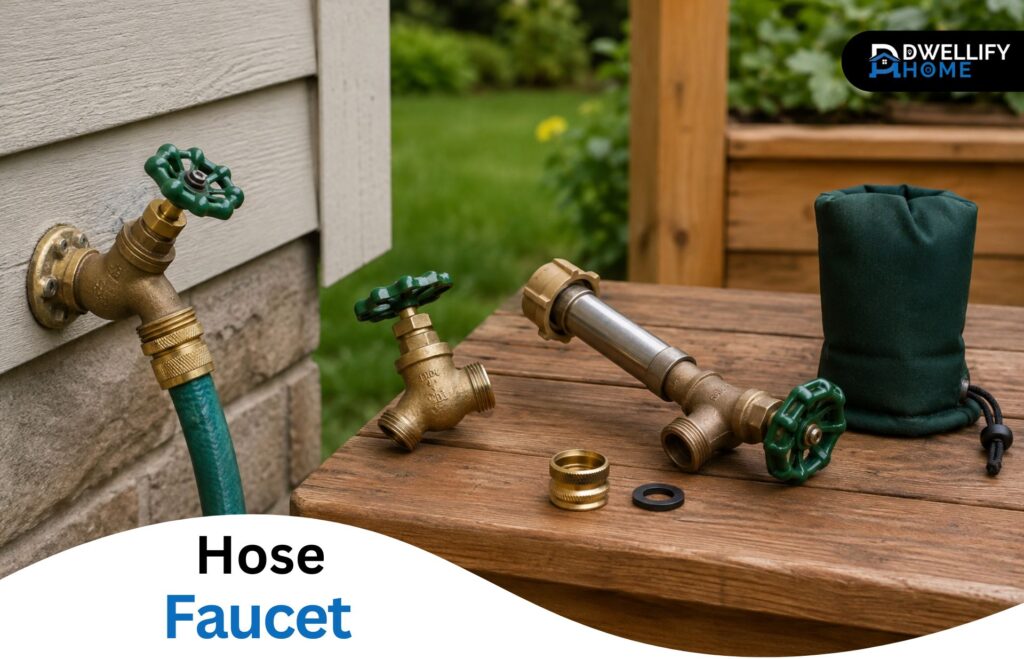
An outdoor faucet may look simple, but its valve design, supply connection, protective features, and ability to drain all affect how reliably it performs. Choosing the wrong model can lead to frustrating leaks, poor compatibility, or freeze damage hidden inside the wall.
Understanding the basic designs makes it easier to select, use, and maintain the right fixture for your climate and household needs.
Short Definition
A hose faucet is a wall-mounted or utility water valve with a threaded garden-hose outlet, providing convenient water access for gardening, cleaning, filling containers, and other outdoor tasks.
Mission Statement
DwellifyHome helps homeowners, renters, and home lovers create practical, stylish, and comfortable spaces through clear, trustworthy guidance.
What Is a Hose Faucet and What Is It Used For?
A hose faucet is a water valve with a threaded outlet designed to accept a garden hose. It is normally installed on an exterior wall, in a garage, or in another utility area where convenient access to the home’s water supply is needed.
Common uses include:
- Watering lawns, gardens, and container plants
- Connecting sprinklers or irrigation timers
- Washing vehicles, siding, patios, and outdoor furniture
- Filling buckets, watering cans, or small pools
- Supplying water to pressure washers and other compatible equipment
The threaded hose outlet is only one side of the fixture. The inlet on the house side must also match the supply pipe and installation method. Two faucets that look identical from outside may have completely different inlet connections.
Hose Faucet, Hose Bib, Spigot, or Sillcock—What Is the Difference?
These terms overlap, and their use varies between homeowners, manufacturers, retailers, and plumbing trades.
- Hose faucet is a general homeowner-friendly term for a faucet that accepts a garden hose.
- Hose bib or hose bibb commonly describes a wall-mounted valve with a threaded hose outlet.
- Spigot is an informal term that can refer to several outdoor or utility water outlets.
- Sillcock often refers to a fixture extending through an exterior wall. The term is frequently associated with frost-free models, although not every product labeled as a sillcock has the same freeze-protection design.
- Wall hydrant may describe a heavier-duty, recessed, lockable, or commercial-style outdoor fixture.
The product name alone does not confirm how the fixture operates. Check its inlet connection, valve mechanism, wall depth, freeze protection, and backflow features before choosing a replacement.
How Does a Hose Faucet Work?
A hose faucet controls water moving from the home’s supply pipe to the threaded exterior outlet. Turning the handle opens an internal valve so water can pass through the body. Closing it presses a sealing component against a valve seat or rotates a ball mechanism to stop the flow.
Main Parts of a Hose Faucet
Although designs vary, homeowners may encounter these parts:
- Handle: Opens and closes the valve.
- Stem: Transfers movement from the handle to the internal valve.
- Packing or stem seal: Helps prevent water from leaking around the handle.
- Washer and valve seat: Create the seal in many multi-turn models.
- Valve body: Contains the working components and water passage.
- Inlet: Connects the fixture to the house-side plumbing.
- Hose outlet: Provides the external threaded connection.
- Vacuum breaker: Helps prevent contaminated water from being drawn backward into the potable supply.
- Mounting flange: Secures many wall-mounted models to the building.
Multi-Turn vs. Quarter-Turn Operation
A traditional multi-turn faucet uses several handle rotations to raise or lower a stem. This provides gradual flow adjustment, but its washer, packing, or valve seat may eventually require service.
A quarter-turn model generally uses a ball-style valve. It opens and closes with a 90-degree handle movement, making it convenient for frequent use or for someone with limited hand strength. It offers faster operation, though typically less gradual adjustment than a multi-turn design.
Main Hose Faucet Designs and Protection Features
A fixture’s construction, valve operation, freeze protection, and backflow protection are separate characteristics. One product might be frost-free, quarter-turn, and anti-siphon at the same time.
Standard Hose Bibbs
A standard hose bibb has its shutoff mechanism close to the exterior handle. It is compact, familiar, and often straightforward to service when the plumbing connection remains accessible.
Its main limitation is cold-weather exposure. Water near the valve can freeze if the fixture or connected supply line is not properly protected and winterized. Standard models are better suited to mild climates, protected locations, or plumbing systems with an interior shutoff and appropriate drainage arrangement.
Frost-Free Sillcocks
A frost-free sillcock has a long stem that places the actual shutoff point deeper inside the building, where temperatures should remain warmer. After the valve is closed, water in the outer barrel must be able to drain.
Freeze resistance depends on correct installation. The barrel generally needs to pitch slightly toward the exterior, and hoses, splitters, timers, and nozzles must be removed before freezing weather. An attachment can trap water inside the barrel and defeat the drainage design.
A frost-free fixture can still freeze if it is installed incorrectly, remains connected to an attachment, or extends into an unheated area.
Anti-Siphon and Specialty Options
An anti-siphon fixture includes a vacuum breaker or similar backflow-protection feature. This helps prevent water from a hose, chemical sprayer, or outdoor container from being siphoned back into the household water supply.
Anti-siphon and frost-free do not mean the same thing. One addresses backflow; the other reduces freezing risk.
Other options include:
- Loose-key handles for shared or publicly accessible areas
- Recessed wall hydrants for a cleaner or more secure installation
- Hot-and-cold outdoor faucets for washing tasks
- Quarter-turn models for easier operation
- Replacement models designed for PEX, threaded, soldered, or push-fit connections
Compatibility and local plumbing requirements matter more than the number of advertised features.
How to Choose the Right Hose Faucet for Your Home
Choose according to climate, location, plumbing compatibility, backflow needs, and serviceability. Appearance is secondary: the fixture must connect correctly, extend through the wall properly, drain as designed, and remain practical to operate and repair.
Start With Climate, Location, and Intended Use
A standard model may be reasonable for a protected garage in a mild climate. A faucet passing through a northern exterior wall usually needs stronger freeze protection and careful installation.
Consider how the outlet will be used. A frequently operated garden connection may benefit from a large or quarter-turn handle. A loose-key model can discourage unauthorized use on a shared wall, but the removable key must be stored somewhere accessible.
Also check whether the intended equipment has special pressure, flow, backflow, or potable-water requirements.
Match the Inlet, Hose Outlet, and Wall Depth
Do not confuse the house-side inlet with the garden-hose outlet. A common hose may fit the front while the back remains completely incompatible with the supply plumbing.
Retail labels may identify inlets as male or female pipe thread, sweat, PEX, or push-fit. Nominal inlet sizes also vary. Photographing the existing connection and recording its measurements before shopping can prevent an incorrect purchase.
For a frost-free model, wall thickness and stem length are equally important. A body that is too short may not place the valve far enough inside the protected space. One that is unnecessarily long may interfere with interior plumbing or access.
Most residential garden hoses use a standard U.S. hose-thread connection, commonly labeled as 3/4-inch garden-hose thread. Verify the actual product label rather than assuming every imported, specialty, or utility fixture uses the same standard.
Compare Backflow Protection, Materials, Handles, and Repair Parts
Check whether backflow protection is built in or must be added separately. Existing vacuum breakers should not be removed simply because they leak or look unnecessary; replacement requirements can depend on the fixture and local plumbing rules.
Material matters, but it does not overcome poor compatibility or installation. For water that may be used for drinking, food preparation, or edible plants, select a fixture specifically labeled for an appropriate potable-water application.
Finally, look at practical ownership details:
- Can the handle be operated while wearing gloves?
- Are replacement washers, cartridges, or vacuum-breaker kits available?
- Can the model be serviced without opening the wall?
- Is the mounting flange suitable for the wall surface?
- Are manufacturer instructions and model information easy to find?
A serviceable, correctly matched fixture is often more useful than one chosen only for its finish or feature list.
Hose Faucet Installation and Replacement—DIY or Call a Plumber?
A like-for-like replacement may be manageable when the connection is threaded, visible, in sound condition, and easy to support. Hidden joints, soldered plumbing, corrosion, cracked pipes, or uncertain code requirements make professional installation the safer choice.
What Makes a Replacement DIY-Friendly
The project is more approachable when:
- A dedicated shutoff is available and works properly.
- The inlet connection can be clearly identified.
- Both the faucet and connecting pipe are accessible.
- The replacement matches the connection and dimensions.
- The existing pipe is not loose, twisted, corroded, or damaged.
- The manufacturer provides clear installation instructions.
The water must be shut off and the line depressurized before removal. The supply pipe also needs support so turning the fixture does not twist or break a concealed connection. After installation, inspect both the exterior fitting and any accessible interior plumbing while the system is repressurized.
When a Licensed Plumber Is the Safer Choice
Professional help is appropriate when the faucet is soldered, the connection is hidden behind a finished wall, or the pipe moves when the fixture is touched. A plumber should also assess recurring freeze damage, severe corrosion, cracked fittings, uncertain backflow requirements, or a new installation that modifies the supply line.
Water appearing in a basement, crawlspace, or wall cavity after the outdoor faucet is used may indicate a concealed split. Shut off the affected supply and arrange prompt inspection rather than continuing to test the fixture.
How to Use and Maintain a Hose Faucet
Regular inspection and proper seasonal care can prevent small leaks from becoming wall damage or wasted water. Maintenance should focus on the handle seal, spout, hose connection, vacuum breaker, wall mounting, and drainage conditions.
Routine Checks During the Watering Season
Occasionally operate the valve without a hose attached and look for:
- Dripping from the outlet after the valve is closed
- Water around the handle while it is running
- Leakage at the hose coupling
- Persistent spraying from the vacuum breaker
- A loose mounting flange
- Moisture inside the building near the supply connection
- Unusually weak or irregular flow
A leaking hose connection may need a sound hose washer rather than a new faucet. A handle leak may involve the packing or stem seal, while a drip from the outlet can point to a worn washer, cartridge, or valve seat. Match repair components to the exact model whenever possible.
Cold-Weather Care for Standard and Frost-Free Faucets
Before freezing weather, remove hoses, timers, splitters, nozzles, and other attachments. This is essential for frost-free models because the barrel cannot drain if its outlet remains blocked.
For a standard faucet with an interior shutoff and drain arrangement, follow the plumbing system’s winterization procedure. Do not assume an insulated cover can replace proper drainage or freeze protection.
After a hard freeze, inspect the accessible interior side when the faucet is first used. Damage to a frost-free body may not leak until the valve is opened.
Common Hose Faucet Problems and What They May Mean
The location and timing of a leak provide useful clues. A basic washer or seal may be repairable, while leakage inside the wall, a cracked body, or severely deteriorated plumbing requires faster action.
Leaks, Vacuum-Breaker Discharge, and Weak Water Flow
| Symptom | Possible cause | Practical next step |
| Outlet drips while closed | Worn washer, cartridge, or damaged seat | Identify the model and inspect compatible repair options |
| Water leaks around the handle | Loose packing or worn stem seal | Stop using it if tightening or model-specific service is uncertain |
| Hose connection leaks | Missing or damaged hose washer, loose coupling, or damaged threads | Replace the washer and inspect both sets of threads |
| Water sprays from the top | Vacuum-breaker operation, debris, damage, or a failed seal | Brief discharge may occur; persistent spraying needs inspection |
| Flow is weak | Partly closed shutoff, kinked hose, debris, mineral buildup, or supply problem | Test without attachments and compare other fixtures |
| Water appears indoors | Split faucet body, failed joint, or damaged supply pipe | Shut off the supply and call a plumber promptly |
When to Repair, Replace, or Shut Off the Water
Repair may make sense when the fixture body and threads are sound and the problem involves an available washer, packing seal, handle, or model-specific vacuum-breaker kit.
Replacement is usually more practical when the body is cracked, the threads are stripped, corrosion is advanced, repair parts are unavailable, or leaks repeatedly return after appropriate service.
Shut off the water promptly if leakage enters the wall, the fixture separates from its pipe, water cannot be controlled at the handle, or freeze damage is suspected.
Frequently Asked Questions About Hose Faucets
What Size Garden Hose Fits a Hose Faucet?
Most residential outdoor faucets in the United States accept a standard garden-hose connection, commonly labeled 3/4-inch garden-hose thread. This does not identify the supply-side inlet size, which may use a different nominal dimension and connection type. Check both specifications before purchasing a faucet or adapter.
How Can You Tell Whether a Hose Faucet Is Frost-Free?
A frost-free model typically has a long body extending through the wall, with its shutoff point located farther indoors. The exterior appearance alone may not confirm this. Look for a model number, manufacturer description, visible interior connection, or other documentation. A vacuum-breaker cap does not prove that the fixture is frost-free.
Can a Frost-Free Hose Faucet Still Freeze?
Yes. It can freeze when a hose, timer, splitter, or closed nozzle traps water in the barrel. Incorrect slope, an unheated interior location, extreme exposure, or improper installation can also interfere with protection. Remove attachments before freezing weather and follow the manufacturer’s seasonal-care instructions.
Does Every Hose Faucet Need a Vacuum Breaker?
Requirements vary with the plumbing system, fixture, application, and local rules. Backflow protection is commonly used where a hose could contact contaminated water or chemicals. Do not remove an existing device without confirming that the resulting installation remains appropriate. A licensed plumber or local authority can clarify code-sensitive situations.
Why Does a Hose Faucet Spray Water From the Top?
The water may be coming from an anti-siphon vacuum breaker. A brief discharge during a pressure change can be part of its operation, but continuous spraying may indicate debris, damage, incorrect pressure conditions, or a worn component. Use the manufacturer’s specified repair kit or have the fixture inspected.
Can You Replace an Outdoor Hose Faucet Yourself?
A straightforward, like-for-like threaded replacement may be suitable for a capable DIYer when the pipe is accessible, supported, and in good condition. Soldered joints, concealed plumbing, heavy corrosion, freeze damage, or uncertain backflow requirements call for a licensed plumber. Never force a fixture that could twist a hidden pipe.
Choosing the Right Hose Faucet: Final Takeaway
The right fixture must suit the climate, wall depth, supply connection, intended use, and backflow needs of the home. Confirm the inlet and outlet separately, consider future repair access, and disconnect attachments before freezing weather. For hidden damage, corroded plumbing, or uncertain installation requirements, professional help is the safer decision.
Disclaimer
DwellifyHome content is for general informational purposes only. Homes, needs, preferences, budgets, and circumstances vary. Consult a qualified professional for safety, installation, repair, legal, structural, electrical, plumbing, HVAC, or major property decisions.