Auxiliary heat is your heat pump’s backup heater. It switches on by itself when the heat pump alone cannot keep your home warm, and your thermostat shows it as AUX, AUX HEAT, or Stage 2 Heat. In most all-electric systems, it is a set of electric heat strips inside the indoor air handler. In a dual-fuel system, it is the gas furnace.
That little AUX light is not a fault code. It is your system asking for help on a cold morning, during a defrost cycle, or after you raise the thermostat several degrees at once. The catch is cost: backup heat uses far more electricity than the heat pump, so long stretches of aux heat show up fast on your bill. This guide explains when aux heat is normal, when it warns of trouble, and what you can do about it.
What Auxiliary Heat Means on Your Thermostat
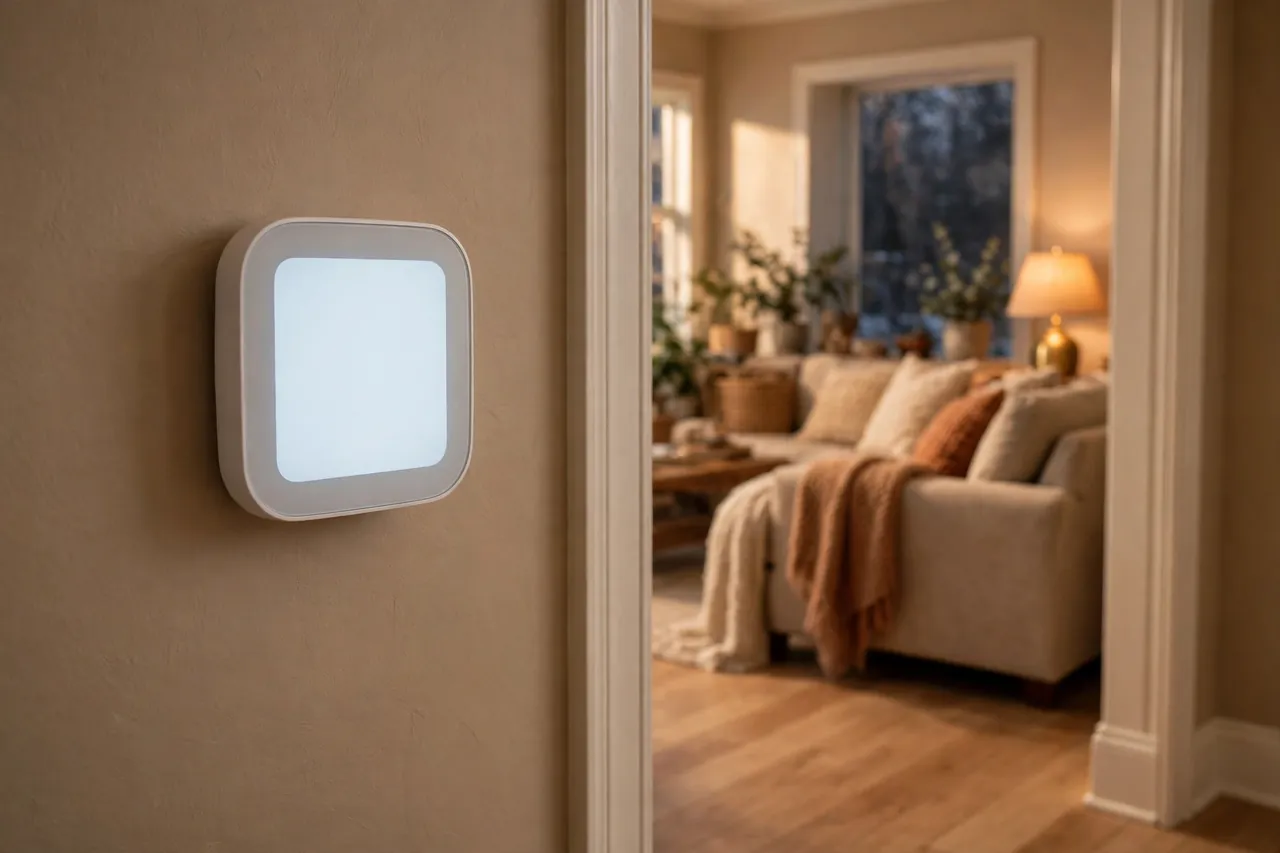
When your thermostat says AUX, it means your heating system has turned on its second heat source. The heat pump is still running, and the backup heat works with it to close the gap between the heat your home needs and the heat the pump can move on its own.
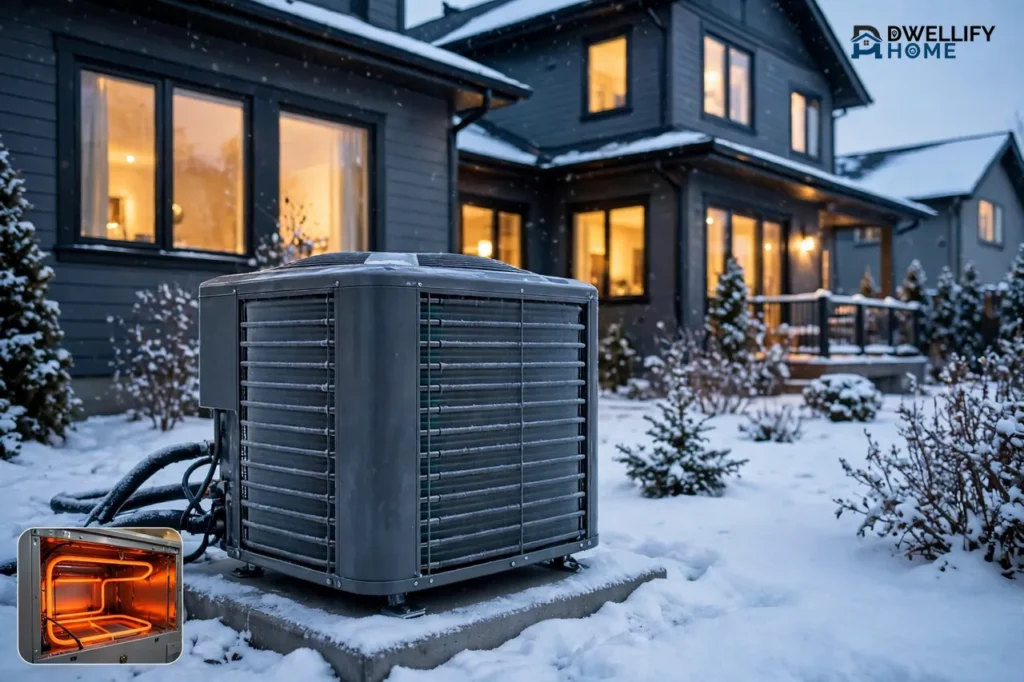
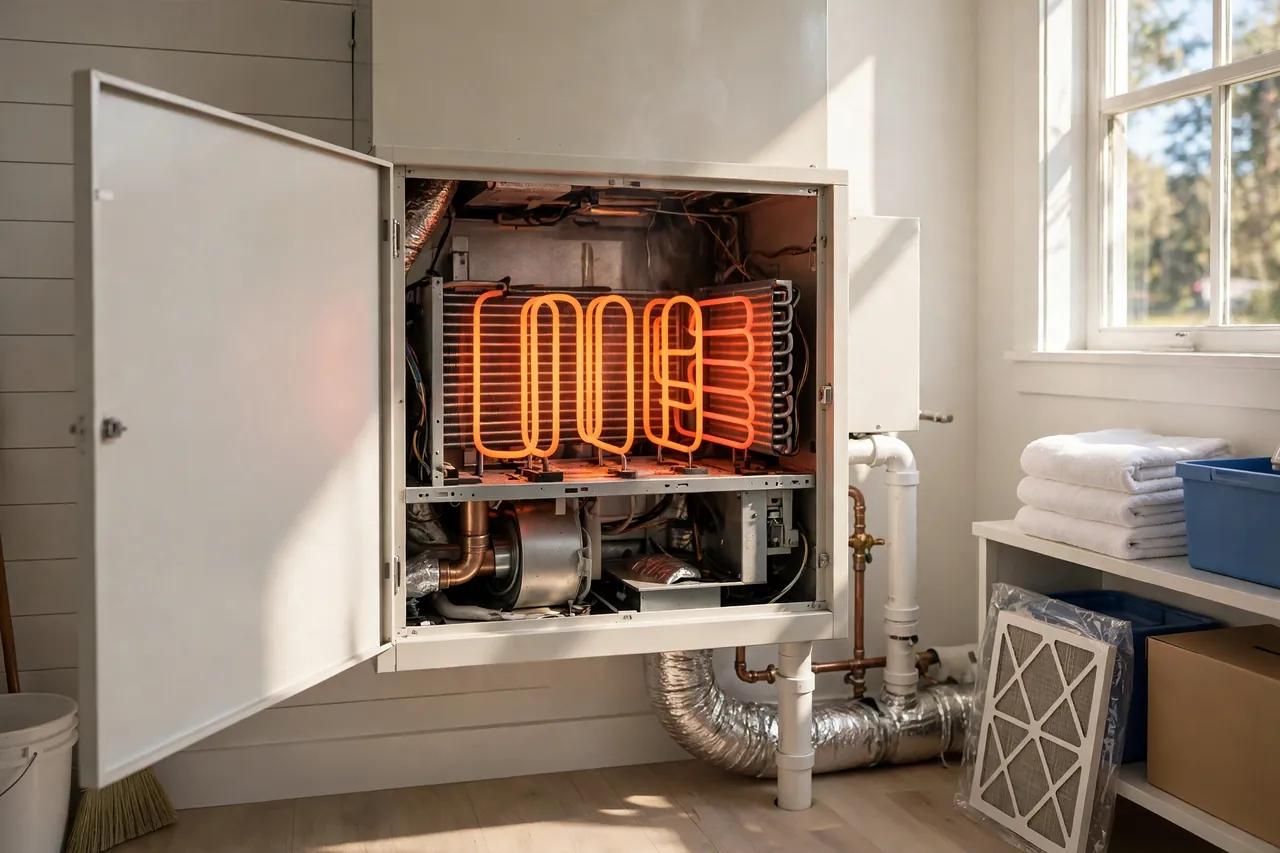
Most American homes with a heat pump use electric heat strips for auxiliary heat. These are metal coils inside the indoor air handler, and they work much like the coils in a toaster. Electricity runs through them, they glow hot, and the blower pushes that warm air through your ducts. They are simple, reliable, and very power-hungry, much like a giant space heater hidden inside your HVAC system.
Some homes have a dual-fuel system instead. There, the backup heat is a gas furnace rather than electric strips. When the heat pump needs help, the controls hand heating over to the furnace. If you have this setup, the furnace is the part that does the heavy lifting on the coldest days, and knowing its gas furnace replacement cost helps you plan for the day it wears out.
You do not turn auxiliary heat on yourself. Your thermostat and system controls decide, based on the outdoor temperature, the indoor temperature, and how far your home sits from the setting you asked for. When the gap closes, aux heat switches off again on its own.
How a Heat Pump Uses Auxiliary Heat
A heat pump does not make heat the way a furnace or a toaster does. It moves heat from the outdoor air into your home, even when that air feels cold to you. Because moving heat takes far less energy than making it, ENERGY STAR explains that a heat pump can deliver up to three times more heat energy than the electrical energy it consumes.
That trick has a limit. As the outdoor air gets colder, it holds less heat to move, and your home loses heat faster at the same time. At some point, the two lines cross: the pump’s output matches your home’s heat loss exactly. HVAC pros call that crossing the balance point. Below it, the heat pump alone cannot keep up, and auxiliary heat fills the gap.
Bryant notes that U.S. Department of Energy guidance puts a typical heating balance point in the 26°F to 32°F range, but that number is only a rough guide. Your real balance point depends on your heat pump’s size and model, how well your home holds heat, and how cold your climate runs. Carrier states plainly that no single outdoor temperature triggers auxiliary heat on all of its models, and modern cold-climate heat pumps can keep heating well below freezing before they ask for help. So do not judge your system by one magic number on a thermometer.
Think of it as a relay race. The heat pump runs the long middle stretch because it is cheap and steady. Auxiliary heat sprints the last leg when conditions get tough, then hands the race back. The table below shows the two runners side by side.
Table: Heat pump only vs. auxiliary heat
| Heating mode | What runs | Cost per unit of heat |
|---|---|---|
| Heat pump only | Compressor moves outdoor heat inside | Lowest |
| Auxiliary heat (electric strips) | Strips make heat, pump keeps running | About 2 to 4 times more |
| Dual-fuel auxiliary heat | Gas furnace takes over heating | Depends on gas and electric rates |
The strips sit inside the air handler of a forced-air heating system, so the same ducts and blower that carry heat-pump warmth also carry aux heat. That is why the air from your vents can feel suddenly hotter when AUX appears: the strips add raw, direct heat to the airstream.
When Does Auxiliary Heat Turn On?
Aux heat has four usual triggers. Three are normal. The fourth means something needs attention.
1. Cold Weather Below the Balance Point
This is the main trigger. On a bitter night, the heat pump runs nonstop and still falls behind. The thermostat sees the indoor temperature slipping below your setting and calls in the strips. A few hours of aux heat during a cold snap is normal, and it is exactly what the backup is for.
2. Defrost Cycles
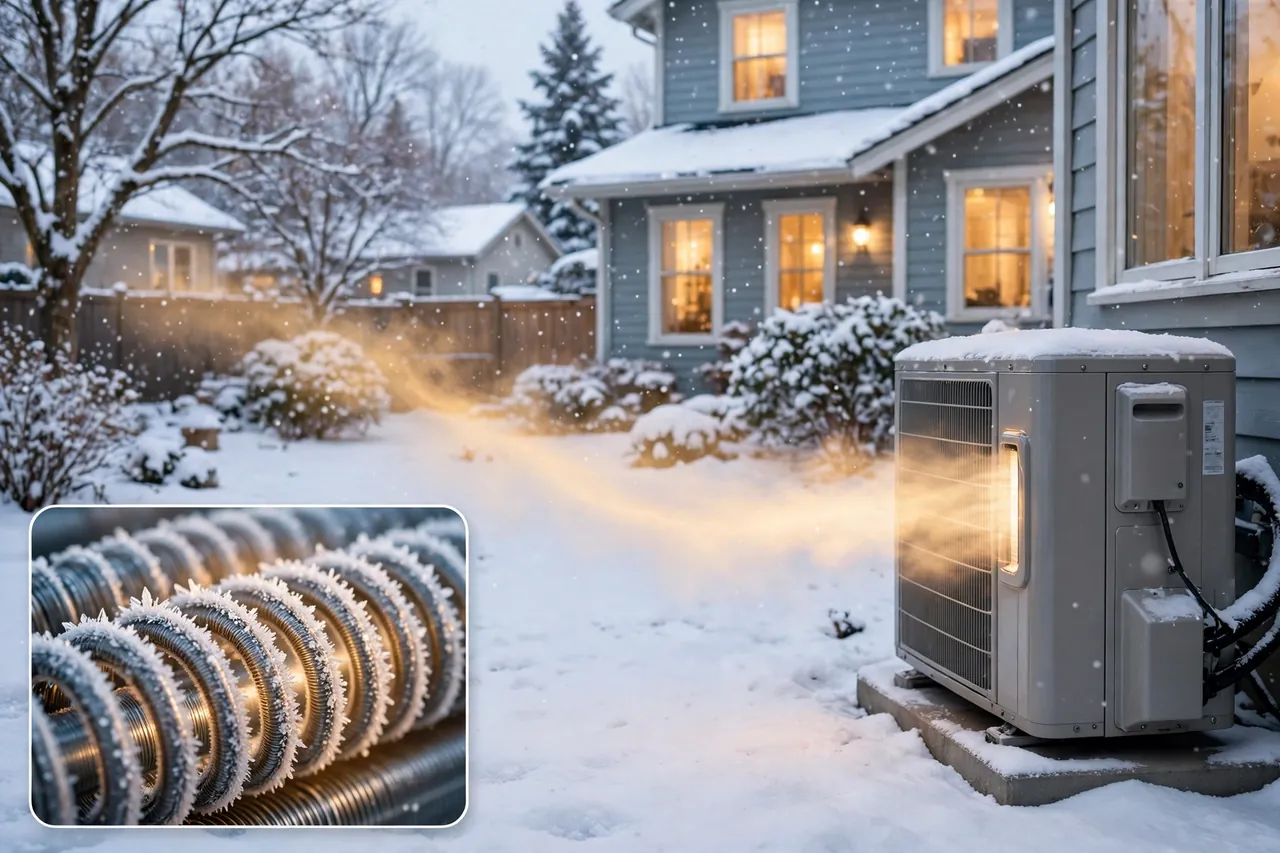
Frost builds on the outdoor coil in cold, damp weather. To clear it, the heat pump briefly runs in reverse and pulls heat from inside your home to melt the ice. That would blow cold air from your vents, so the strips switch on for a few minutes to keep the air warm while the unit defrosts. Defrost cycles are short, and they happen more often near freezing, when the air is damp, than on dry, bitter days.
3. A Big Jump on the Thermostat
If you raise the setting several degrees at once, the thermostat decides the heat pump cannot close that gap fast enough on its own. Carrier notes that raising the thermostat by more than 2 to 3 degrees at once can bring on auxiliary heat. The same thing happens after a deep overnight setback: you wake to a cold house, crank the heat up, and the strips fire to catch up quickly.
4. A Fault in the System
Sometimes aux heat runs because the heat pump cannot do its job, not because the weather is cold. A clogged air filter chokes airflow. Low refrigerant cuts the pump’s ability to move heat. A faulty sensor misreads temperatures. Carrier warns that aux heat running in mild weather above 40°F may point to a dirty air filter, a refrigerant leak, or a faulty sensor. That fourth trigger is the one to act on.

Why Auxiliary Heat Costs So Much
Here is the short version: the heat pump moves heat, and the strips make it. Making heat from electricity is a one-for-one deal. One unit of electricity becomes one unit of heat, nothing more. HVAC pros call that a COP of 1. A heat pump, by contrast, often delivers two to four units of heat for every unit of electricity it uses, because it gathers heat that is already outside.
That gap is why your bill jumps. Every hour the strips run, your system can draw two to four times the electricity it would use on heat-pump power alone for the same warmth. A typical strip bank draws about 10 kilowatts, which is like running several large space heaters at once. A few minutes a day barely shows up. Hours a day, day after day, adds up fast.
The worked example below uses the U.S. average residential electricity rate of 18.16 cents per kWh for August 2026, reported by the U.S. Energy Information Administration and checked on November 5, 2026. One kilowatt-hour holds 3,412 BTU of energy. Your own rate will differ, so check your bill and swap in your number.
Table: What 10,000 BTU of heat costs at 18.16 cents per kWh
| Heat source | Electricity needed | Cost |
|---|---|---|
| Electric heat strips (COP 1) | 2.93 kWh | About 53 cents |
| Heat pump at COP 3 | 0.98 kWh | About 18 cents |
Put another way, a 10-kilowatt strip bank running for one hour uses 10 kWh, which costs about $1.82 at that same average rate. Run those strips for five extra hours a day across a cold month, and the strips alone add about $272 to the month’s bill. That is the math behind the winter bill spike, and it is why aux heat is one of the top reasons your electric bill is so high in winter.
Dual-fuel homes dodge the worst of this. When their aux heat is a gas furnace, the extra cost depends on gas prices, not on electric strips. But the habit is the same: the backup costs more than the heat pump, so the less it runs, the lower the bill.
Is Auxiliary Heat Normal?
Most of the time, yes. Aux heat is a built-in part of your system, not a warning light. The question is not whether it runs, but when and for how long.
These signs are normal. Aux heat comes on for a few minutes during defrost, on the coldest hours of the year, and for a short burst after you raise the thermostat several degrees. Then it switches off, the house holds its temperature, and your bill looks ordinary for the season.
These signs are not normal. Aux heat runs for long stretches on mild days above freezing. It stays on for hours while the outdoor temperature sits above 40°F. Your bill jumps sharply even though the weather stayed mild. The house never reaches the thermostat setting, or the outdoor unit sits silent while the strips do all the work. Any of these means the heat pump is not carrying its share, and the strips are covering for it.
Before you call anyone, check one thing first: your thermostat mode. If someone in the house switched the system to emergency heat by accident, the heat pump is off and the strips are heating your home alone. That mistake alone can make for a very expensive month, and it takes ten seconds to fix by switching back to Heat mode.
What to Check When Aux Heat Runs Too Much
Work through these checks in order, from easiest to hardest. Stop at the step that solves it.
- Check the thermostat mode. Make sure the system is on Heat, not EM Heat. If it says EM Heat, switch it back and watch whether AUX settles down.
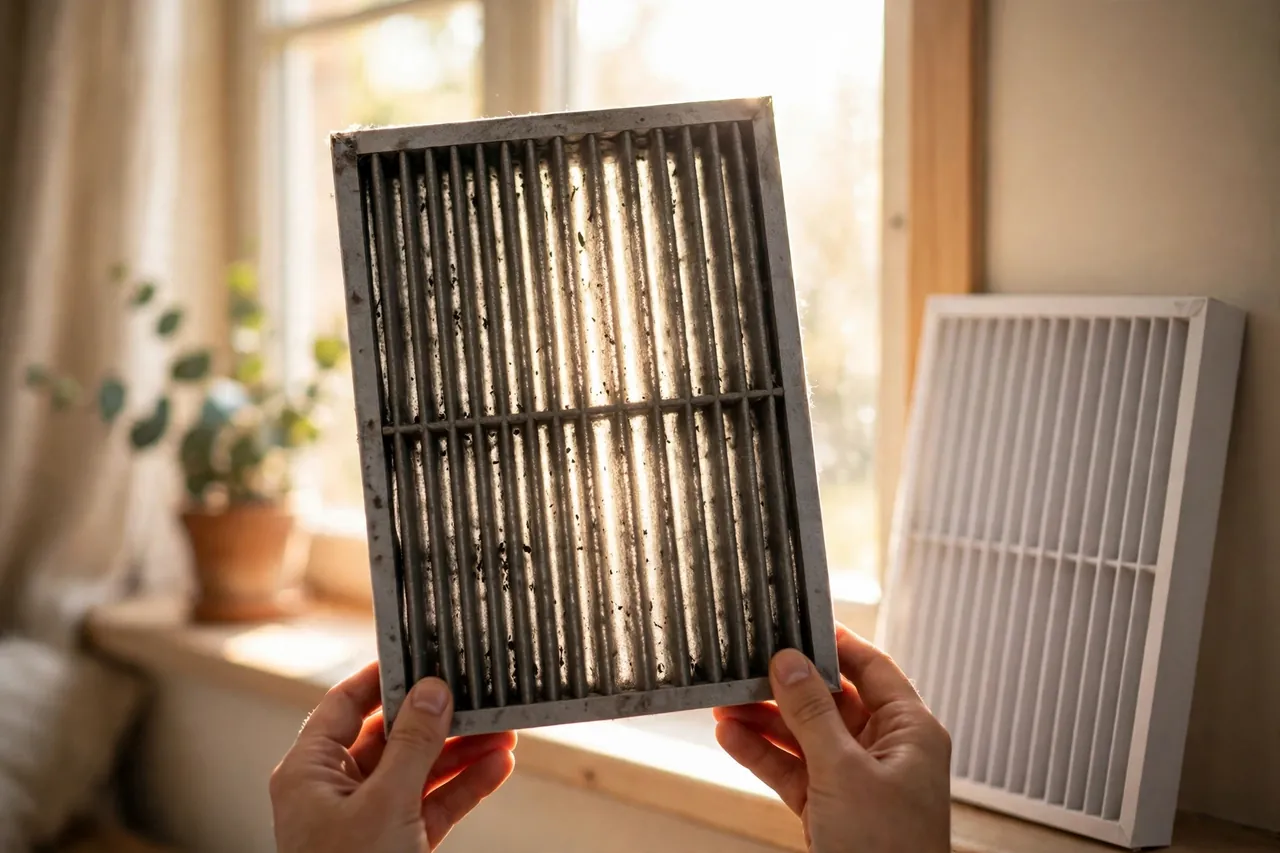
- Check the air filter. Pull it out and hold it up to the light. If you cannot see light through it, replace it. A dirty filter is one of the most common reasons a heat pump leans on aux heat in mild weather.
- Look at the outdoor unit. Clear away leaves, snow, and ice from around it, and make sure nothing blocks the fan. A buried or blocked outdoor unit cannot gather heat well.
- Shrink your setbacks. If you drop the thermostat 8 degrees overnight, the morning recovery will call in the strips. Try a smaller setback of 2 or 3 degrees, or none at all on the coldest nights.
- Watch the pattern for a few days. Note the outdoor temperature, the time of day, and how long AUX stays on. A pattern that points to mild weather or every morning tells a technician exactly where to look.
- Call a qualified HVAC technician. If aux heat still runs for hours above 40°F, or the house cannot hold its setting, the cause may be low refrigerant, a bad sensor, or a failing part. Those checks need gauges, meters, and training, so leave them to a pro.
If the technician finds the heat pump is simply too small for your home, that is a sizing problem, not a repair problem. A system that cannot carry your house on ordinary winter days will lean on the strips all season. In that case, learning how to buy a new HVAC system and how to choose a heating and air conditioning system will help you pick a replacement that fits your home and climate.
How to Keep Auxiliary Heat From Running So Often
You cannot remove aux heat from the picture, and you should not want to: it keeps your home warm on the nights the pump cannot. But you can cut how often it runs, and every hour you save is money back.
- Raise the thermostat slowly. Nudge it up 1 or 2 degrees at a time and give the heat pump 30 minutes to catch up before you nudge it again. Big jumps are the easiest aux trigger to avoid.
- Keep setbacks small. A deep overnight setback feels thrifty, but the morning recovery often burns more in strip heat than the night saved. A 2- or 3-degree setback is the safer habit with a heat pump.
- Change the filter on schedule. Check it monthly in winter and replace it when it looks dirty. Clean airflow is the cheapest efficiency fix there is.
- Seal drafts and add insulation. Every bit of heat your home keeps is heat the pump does not have to replace, which keeps you above the balance point longer. Start with the basics in our guide to faced vs. unfaced insulation, then work through the full how to winterize a house checklist before the cold sets in.
- Let a smart thermostat ramp up slowly. Many smart thermostats can raise the temperature in small steps on their own, which avoids the big jump that calls in the strips. Look for an adaptive recovery or smart recovery setting.
- Keep the outdoor unit clear all winter. Snow, ice, and leaves around the coil force the pump to work harder and defrost more often. The same cold snap that drives aux heat can also freeze exposed pipes, so know what temperature water pipes freeze at and protect them before the first hard freeze.
Auxiliary Heat and Emergency Heat: One Short Note
Auxiliary heat and emergency heat use the same backup heater, but they are not the same thing. Aux heat is automatic: the thermostat brings it in to help the heat pump, then shuts it off. Emergency heat is a manual thermostat setting that turns the heat pump off entirely and runs only the backup, and it stays on until you switch it off. Use it only when the heat pump has broken down and you are waiting for a repair. For the full side-by-side explanation, read our guide to EM heat vs. heat.
Auxiliary Heat at a Glance: Quick Reference
Keep this table handy the next time AUX lights up on your thermostat.
Table: Aux heat quick reference
| Fact | What it means for you |
|---|---|
| What it is | Automatic backup heat: electric strips or a gas furnace |
| When it runs | Deep cold, defrost cycles, big thermostat jumps, faults |
| What it costs | About 2 to 4 times more per unit of heat than the pump |
| Normal use | Short bursts in cold weather and during defrost |
| Warning sign | Long runs above 40°F or a sharp bill jump in mild weather |
| First check | Thermostat mode, then the air filter |
Related Guides
EM Heat vs Heat: What Each Thermostat Setting Does and When to Use It · What Is Forced Air Heating? How It Works, Pros and Cons · How to Winterize a House: The Complete Room-by-Room Checklist
Frequently Asked Questions
What does AUX heat mean on my thermostat?
AUX means your heat pump’s backup heat is on. In an all-electric system, that is the electric heat strips in the air handler. In a dual-fuel system, it is the gas furnace. It switches on by itself during defrost cycles and when the heat pump cannot keep up with your thermostat setting.
Is it normal for aux heat to come on?
Yes, in short bursts. It is normal during defrost cycles of a few minutes and during the coldest hours of the year. It is not normal for aux heat to run for long stretches on days above freezing, or to stay on for hours when the outdoor temperature is above 40°F.
Why is my auxiliary heat running when it’s not that cold?
Aux heat in mild weather usually means the heat pump cannot do its job. Common causes are a dirty air filter, low refrigerant, a faulty sensor, or a thermostat that was raised several degrees at once. Check the filter first, then call a qualified HVAC technician if it keeps happening.
Is auxiliary heat expensive to run?
Yes. Electric auxiliary heat turns one unit of electricity into one unit of heat, while a heat pump can deliver two to four units of heat from the same electricity. At the U.S. average rate of 18.16 cents per kWh (August 2026, EIA), strips cost about three times more per unit of heat than a heat pump running at COP 3.
What is the difference between aux heat and emergency heat?
Aux heat is automatic: it helps the heat pump and switches off when the house catches up. Emergency heat is a manual thermostat setting that turns the heat pump off and runs only the backup heat until you switch it off. Use emergency heat only when the heat pump has broken down. Our guide to EM heat vs. heat explains the two modes in full.
This guide explains how your heating system works. It is not a repair manual. Electrical and heating-system work can be dangerous, so leave refrigerant, wiring, and control-board work to a qualified HVAC technician, and call one promptly if your system runs on backup heat for hours in mild weather or cannot hold your thermostat setting.
The next time AUX appears on your thermostat, do not panic — check the outdoor temperature and the clock. A few minutes on a freezing morning is your system working as designed. Hours on a mild day is your system asking for help, and the filter check above is the fastest place to start.