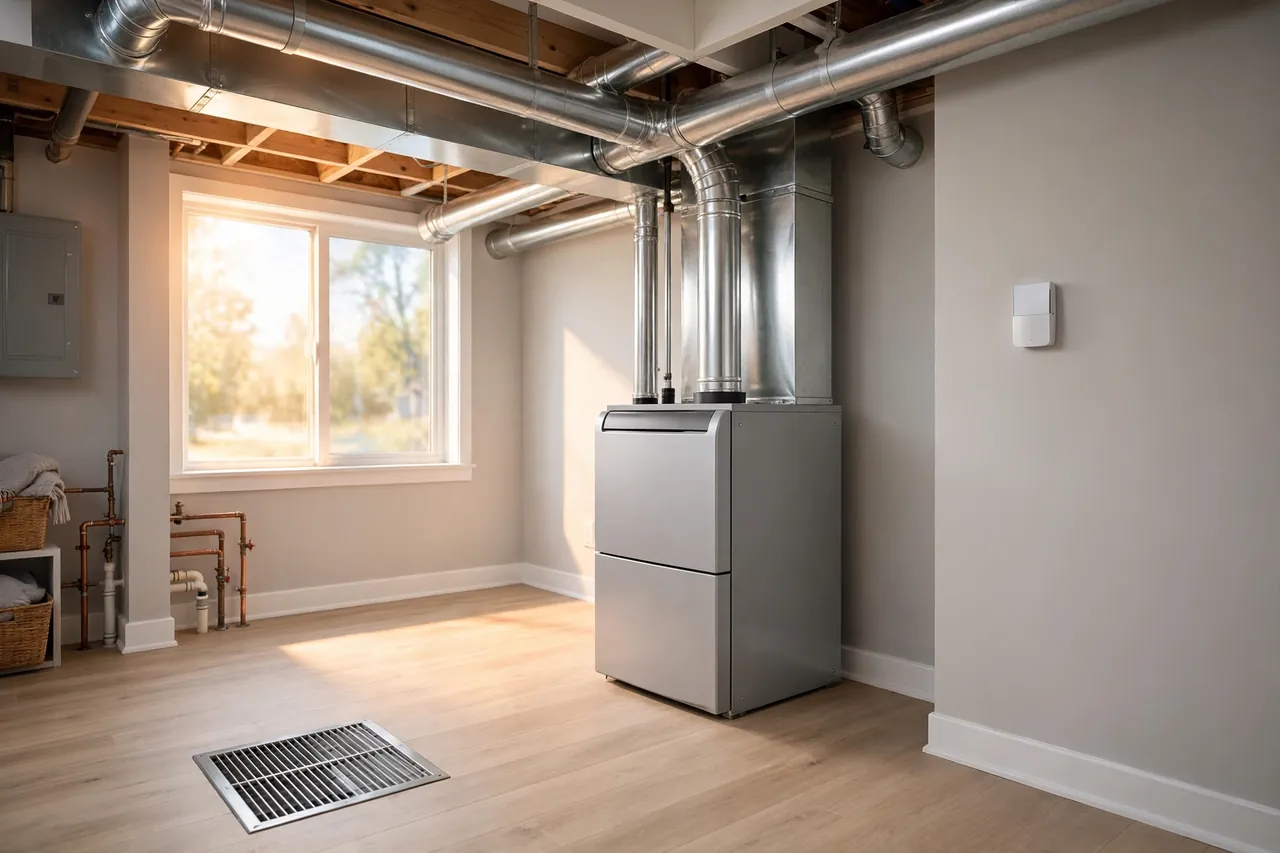
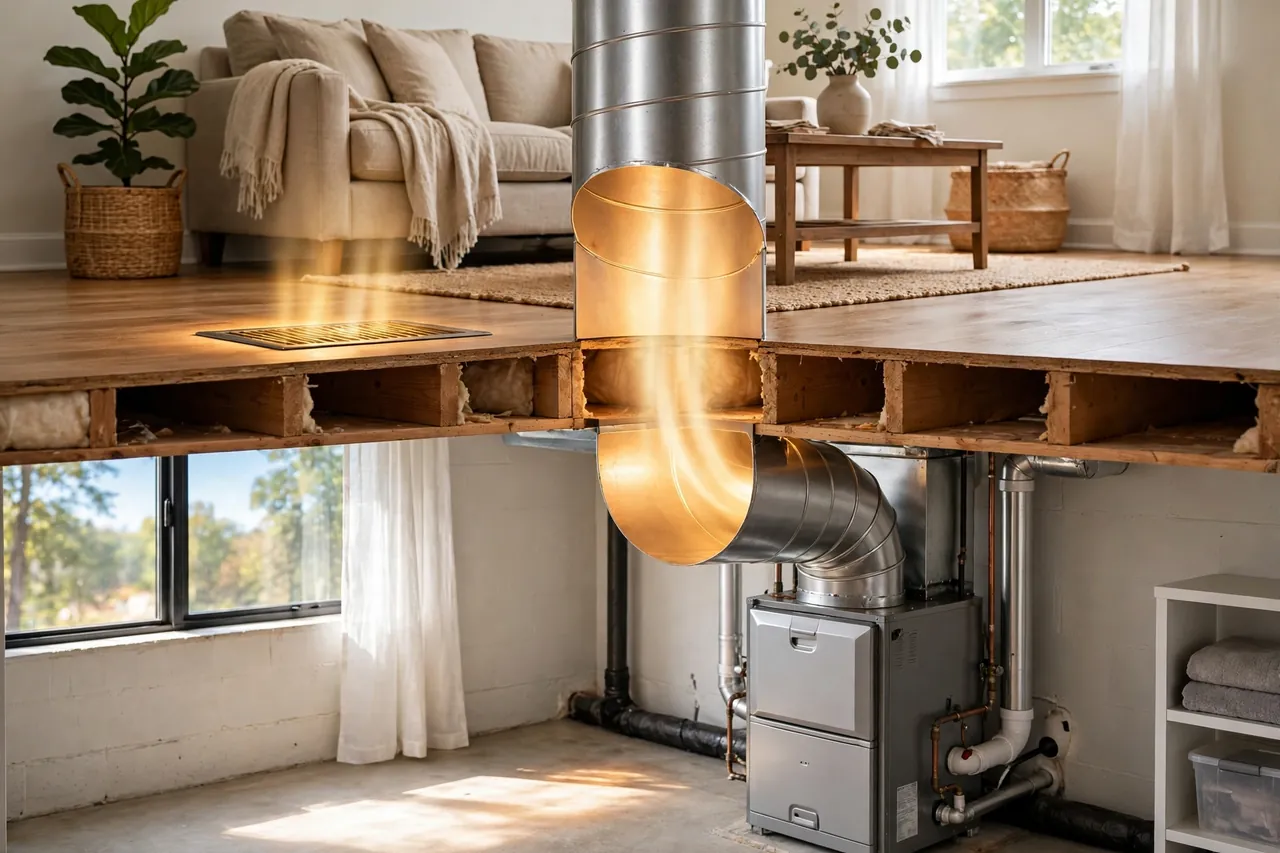
Forced air heating is a home heating system that warms air in one central spot, then uses a fan called a blower to push that warm air through ducts and out of vents into every room. A furnace or a heat pump makes the heat, the ducts carry it, and a thermostat tells the system when to start and stop. Once the air in a room cools, return ducts pull it back to be warmed again, so the same air keeps looping through your home.
If your home has floor or wall vents and one thermostat controls the heat for the whole house, you almost certainly have a forced-air system. It is the most common way American homes heat, and the same ductwork often carries cool air in summer too. This guide explains each part, walks through the heating cycle step by step, weighs the pros and cons, and shows you the simple care that keeps the system running well.
What Is Forced Air Heating?
Forced air heating is a way of moving heat, not a single piece of equipment. The word “forced” describes the fan that pushes air through the house. The heat itself can come from a gas furnace, an electric furnace, an oil furnace, or a ducted heat pump. Change the heat source and you still have forced air heating, because the delivery method stays the same: warm air, blown through ducts.
That point matters when you talk to a contractor. Saying “I have forced air heating” tells them how heat reaches your rooms, but it does not tell them which equipment or fuel your home uses. A gas furnace and a heat pump both feed the same kind of ductwork, yet they work very differently, cost different amounts to run, and need different care.
A forced-air system heats the air in your rooms. That is different from radiant heat, which warms floors, walls, or radiators and lets the heat rise from those surfaces. Forced air warms a cold house fast, because hot air pours out of the vents within minutes of the system starting. Radiant heat feels steadier and quieter, but it takes longer to warm a cold room. Neither one is right for every home, and the comparison later in this guide will help you see the trade-off clearly.
The Parts of a Forced Air System
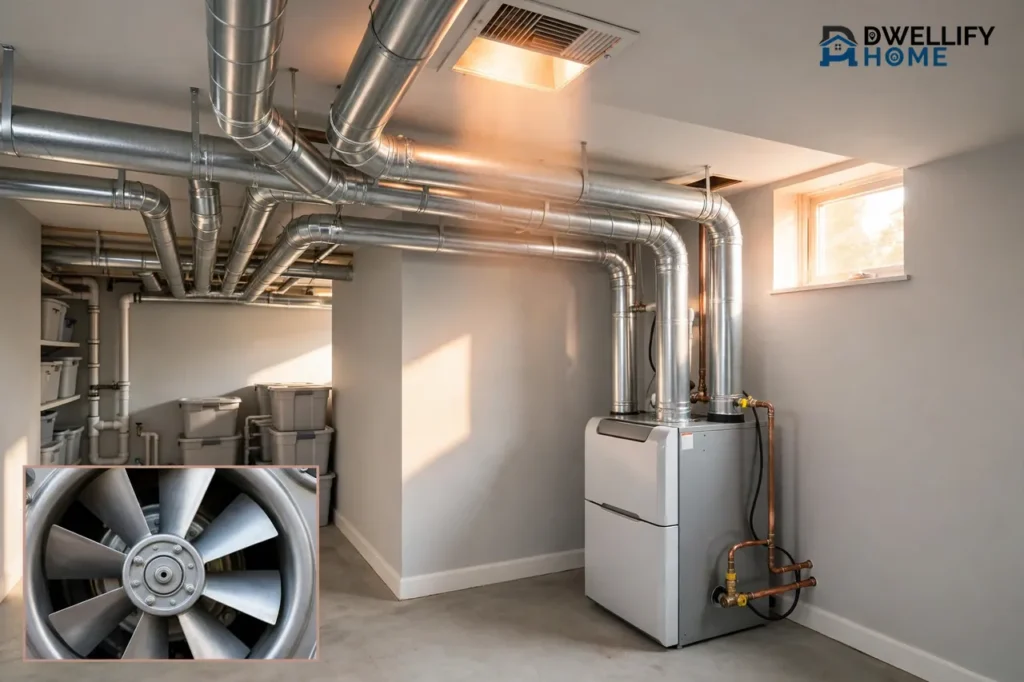
Every forced-air system has the same six parts, working as one team. Learn what each one does, and most heating problems start to make sense. Furnace maker Lennox lists the same core parts, furnace, blower, ductwork, vents, and thermostat, in its homeowner guide to forced air heating.
The furnace or heat pump
This is the heat source. A furnace burns natural gas, propane, or oil, or it uses electric heating elements, to warm the air. A heat pump works differently: it moves heat from outside air into your home instead of making heat by burning fuel. If your heat source is a heat pump, you may sometimes hear about auxiliary heat, the backup heat that kicks in on very cold days. Heat pumps also have an emergency setting, and our guide to em heat vs heat explains when that setting helps and when it wastes money.
The blower
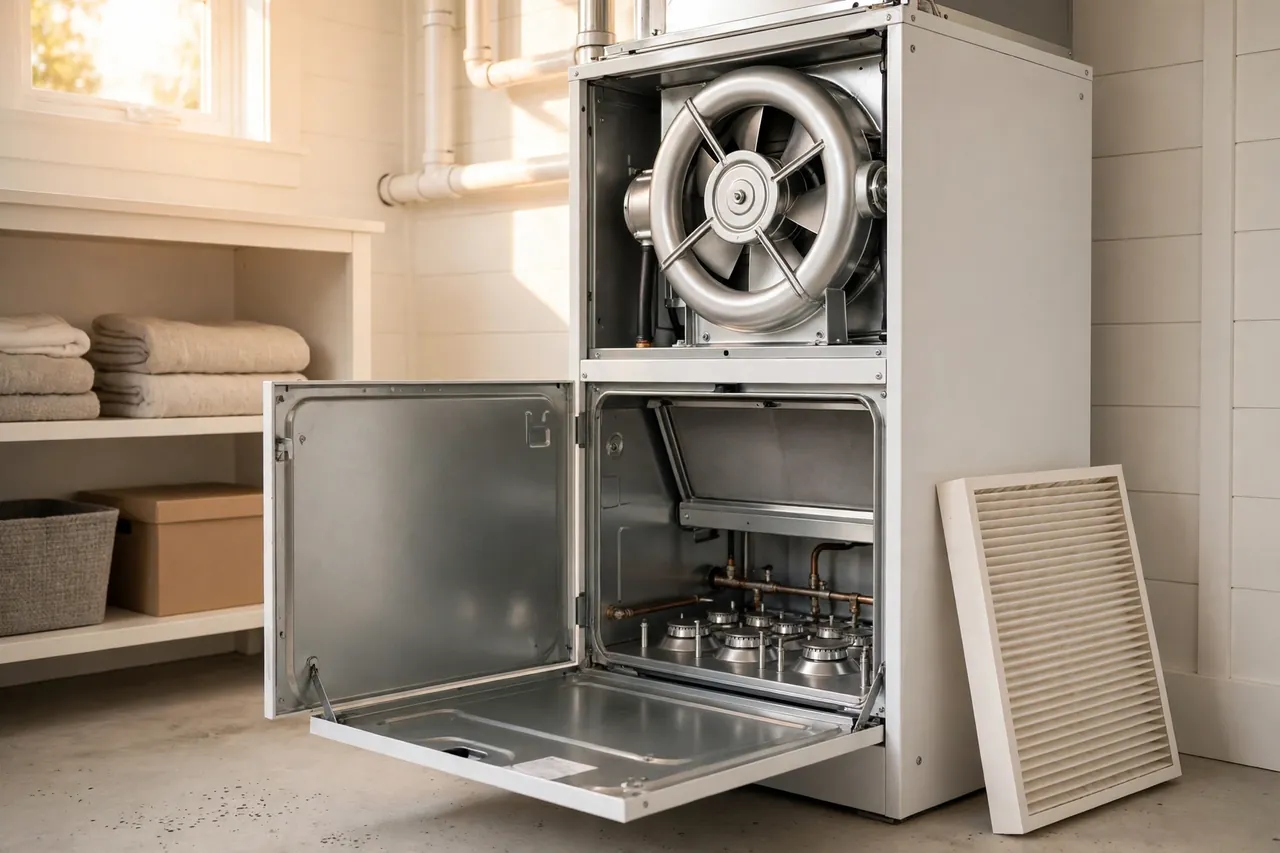
The blower is a strong fan inside the furnace or air handler. It pulls cool air in from your rooms and pushes warm air back out through the ducts. When the blower runs, you hear the soft rush of air at the vents. A weak or dirty blower means weak airflow, even if the furnace itself works fine.
The ductwork
Ducts are the metal or flexible tubes hidden in your walls, attic, basement, or crawl space. Supply ducts carry warm air out to the rooms. Return ducts carry cooler room air back to the furnace to be warmed again. Ducts do quiet, unseen work, and leaky ducts waste more energy than most homeowners guess. According to ENERGY STAR, in a typical house about 20 to 30 percent of the air that moves through the duct system is lost through leaks, holes, and poorly connected ducts, which raises bills and leaves rooms hard to keep comfortable. You can read the full guidance on the ENERGY STAR duct sealing page.
The supply vents and return grilles
Supply vents, also called registers, are the grilles in your floors, walls, or ceilings where warm air comes out. Return grilles are usually larger and sit in a hallway or near the floor. They pull room air back into the system. Block a supply vent with a couch or a rug, and that room gets less heat. Block a return grille, and the whole system has to work harder.
The thermostat
The thermostat is the boss. It senses the room temperature and tells the furnace or heat pump when to turn on and off. Set it to 68 degrees, and the system heats until the room reaches 68, then it rests until the temperature drops again. A programmable or smart thermostat can lower the temperature while you sleep or are away, then warm the house before you get home.
The air filter
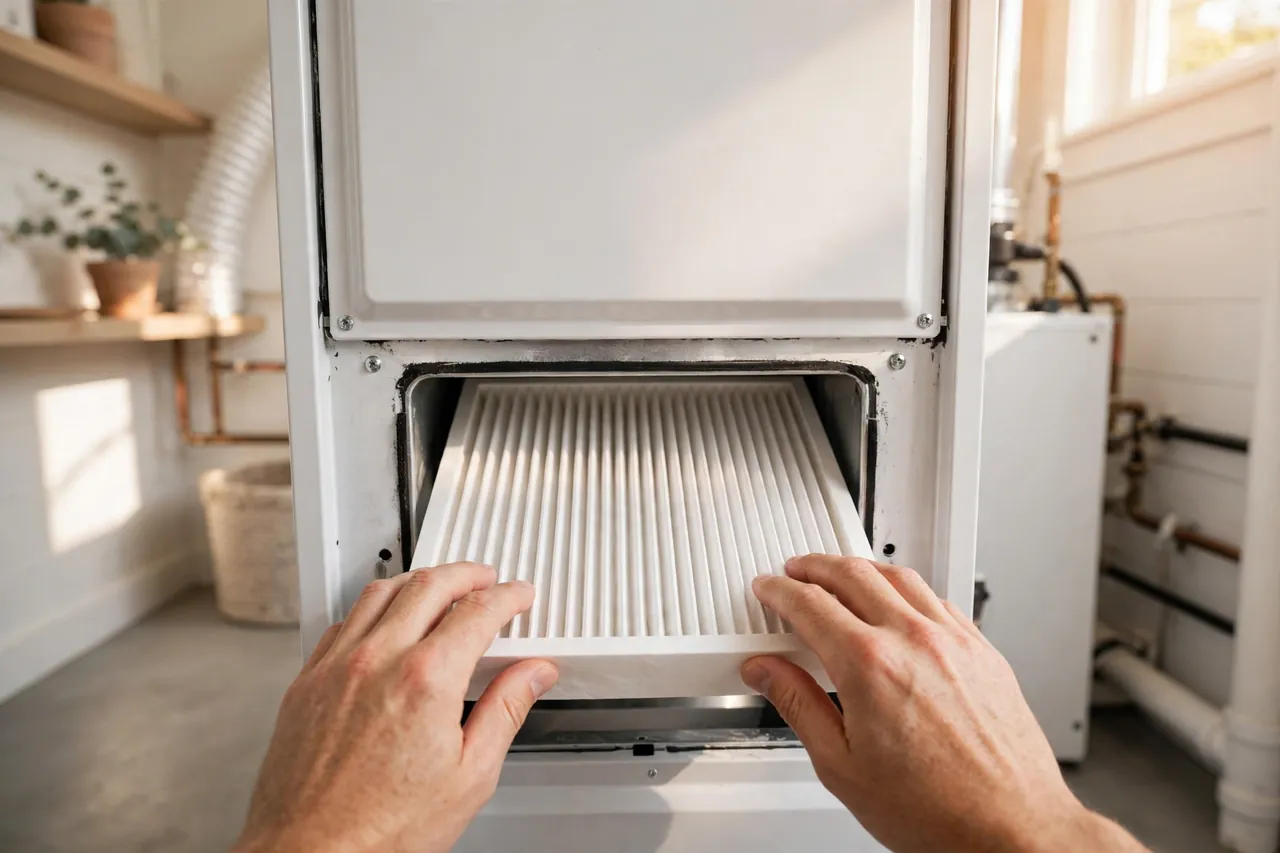
The filter sits where return air enters the furnace. It catches dust, pet hair, and other bits before they reach the blower and the heating parts. A clean filter protects the equipment and keeps air moving freely. A clogged filter chokes airflow, and that is one of the most common causes of weak heat and high bills.
How Forced Air Heating Works, Step by Step
The heating cycle is a loop, and it repeats all day in cold weather. Here is what happens, in order.
- The thermostat senses that the room has cooled below the temperature you set, and it signals the heating equipment to start.
- The furnace lights its burner or switches on its heating elements, or the heat pump starts moving heat indoors. In a gas furnace, the flame warms a sealed metal box called a heat exchanger, and the heat exchanger warms the air around it without letting exhaust mix into your breathing air.
- The blower starts and pulls cool room air in through the return ducts and across the filter.
- The blower pushes the warmed air through the supply ducts and out of the registers in each room.
- Warm air fills the rooms, and the cooler air left behind gets drawn back into the return ducts for another trip through the furnace.
- When the thermostat reads the temperature you set, it tells the system to stop. The cycle rests until the house cools again.
One full cycle takes only a few minutes in a well-sized system. Short, frequent cycles, called short cycling, usually mean something is wrong, such as a clogged filter, a thermostat in a drafty spot, or equipment that is too large for the house. If your system starts and stops every few minutes, check the filter first, then call a technician if the pattern continues.
What Heats the Air? Furnace vs. Heat Pump
Most forced-air homes use one of two heat sources. Both feed the same ducts, but they heat very differently.
Gas, propane, oil, or electric furnace
A furnace makes heat. A gas or oil furnace burns fuel, and an electric furnace runs current through heating elements. Furnaces heat fast and work well in very cold weather, which is why they are common across the northern United States. The U.S. Department of Energy measures a furnace by its AFUE rating, short for Annual Fuel Utilization Efficiency. The Department of Energy explains that an AFUE of 90% means 90% of the energy in the fuel becomes heat for the home and the other 10% escapes, and it groups high-efficiency furnaces at 90% to 98.5% AFUE. You can find that explanation in the Department of Energy Guide to Home Heating and Cooling.
Furnace costs vary widely by size, fuel, and region, so this guide gives no price here. If you are budgeting for a replacement, read our guide to gas furnace replacement cost for the full breakdown of equipment, labor, and the factors that move the number.
Ducted heat pump
A heat pump moves heat instead of making it. In winter it pulls heat from outdoor air, even cold air, and sends it inside through the indoor coil. In summer it runs in reverse and cools the house through the same ducts. One system gives you heating and cooling, and it can be very efficient in mild climates. In very cold weather, though, a heat pump works harder and may need backup heat. That backup is auxiliary heat, and on the coldest nights it can raise your electric bill sharply. If your bill jumps in a cold snap, our guide to why your electric bill is so high walks through the likely causes, including backup heat running more than it should.
The table below sums up the two heat sources at a glance.
Table: Furnace vs. heat pump as a forced-air heat source
| Feature | Furnace | Ducted heat pump |
|---|---|---|
| How it heats | Burns fuel or uses electric elements to make heat | Moves heat from outdoor air indoors |
| Cooling too? | No, needs a separate air conditioner | Yes, same system cools in summer |
| Best in | Very cold climates | Mild to moderate climates |
| Cold-weather weak spot | Fuel cost and exhaust venting | Needs backup heat on the coldest days |
Forced Air vs. Radiant, Hydronic, and Baseboard Heat
Forced air is only one way to heat a home. The others heat surfaces or water instead of air, and the feel in the room is different.
Radiant floor heat runs warm water, or electric coils, under the floor. The floor warms your feet first, and the heat rises gently. Hydronic heat is the same idea through radiators or baseboards: a boiler heats water, and the hot water warms metal panels that give off heat into the room. Electric baseboard heaters warm the air right beside the wall with an electric element, room by room, with no ducts at all.
Forced air wins on speed and on doing two jobs with one set of ducts. Radiant and hydronic heat win on steady, quiet comfort and even temperatures from floor to ceiling. Baseboard heat wins on simplicity and room-by-room control, but it heats slowly and can cost more to run in a whole house.
Table: How forced air compares with other heating types
| Feature | Forced air | Radiant / hydronic | Electric baseboard |
|---|---|---|---|
| Heats by | Warm air through ducts | Warm floors or radiators | Heated panels in each room |
| Speed | Fast | Slow and steady | Slow, room by room |
| Cooling too? | Yes, same ducts | No, needs separate cooling | No |
| Noise | Some blower and air noise | Silent | Silent |
| Air movement | Moves dust and allergens | Almost none | Very little |
| Best for | Whole-house heat plus cooling | Even, quiet comfort | Small spaces, add-on rooms |

The Pros of Forced Air Heating
Forced air became the most common heating method in American homes for good reasons, and most of them are practical.
- Fast warmth. Warm air reaches the rooms within minutes of the system starting, so a cold house feels comfortable quickly after you get home.
- One system, two seasons. The same ducts, blower, and thermostat can carry cool air in summer, so you do not need a second distribution system for air conditioning.
- Even coverage. A well-designed duct system reaches every room from one central unit, with no heater to install in each room.
- Built-in filtration. The filter catches dust and pet hair before they reach the equipment, and you can upgrade to a better filter or add a whole-home humidifier or air cleaner at the same central point.
- Easy to find help. Furnaces, blowers, and ductwork are standard equipment, so most HVAC technicians know them well, and parts are easy to get.
- Works with smart controls. Programmable and smart thermostats pair naturally with forced air, and zoning dampers can send more heat to the rooms that need it.
The Cons of Forced Air Heating, and What to Do About Them
No system is perfect, and forced air has real downsides. The good news is that most of them have a fix.
- Leaky ducts waste energy. As noted above, ENERGY STAR puts typical duct air loss at 20 to 30 percent. The fix is sealing accessible duct joints with mastic sealant or metal tape, and insulating ducts that run through attics, garages, or crawl spaces. Never use ordinary cloth duct tape: ENERGY STAR warns it does not last. If your ducts run through cold, unconditioned space, faced vs. unfaced insulation explains which insulation type suits that job.
- Dry air in winter. Warm, moving air can dry out your home, leaving dry skin and sore throats. A whole-home humidifier on the duct system adds moisture back, and it is far more effective than a small room unit.
- Dust and allergens move around. The same air that warms you also carries dust, pollen, and pet dander from room to room. Change the filter on schedule, vacuum the return grilles, and keep the area around the furnace clean.
- Some noise. You will hear the blower start and the rush of air at the vents, and old metal ducts can tick or pop as they warm and cool. Newer variable-speed blowers run quieter and more evenly than old single-speed ones.
- Uneven rooms. Rooms far from the furnace, or above a garage, often run colder. Duct leaks, blocked vents, and thin insulation are the usual causes, not a weak furnace. The troubleshooting table below will help you sort it out.
- Temperature swings. Because the system heats in bursts, the room can feel warm right after a cycle and cool again before the next one. A two-stage or variable-speed furnace softens those swings.
How to Tell If You Have Forced Air Heating
Walk through your home and look for the signs. You have forced air heating if you can check off most of these.
- You have floor, wall, or ceiling vents with slats you can open and close.
- You have a furnace or air handler in a basement, closet, attic, or utility room.
- One thermostat controls the heat for the whole house, or for a whole zone.
- Warm air blows out of the vents when the heat runs, and you can feel the airflow with your hand.
- The same vents blow cool air in summer, if you have central air conditioning.
If instead you have hot-water radiators, warm floors, or electric panels along the baseboards with no vents and no ducts, you have a different kind of heat. That matters when you shop for parts or call a technician, so note which one you have before you make the call.
Is Forced Air Heating Right for Your Home?
Forced air fits most homes well, and it fits best in three cases. First, your home already has ductwork in good shape. Adding ducts to a home that never had them is the expensive part, and it can eat up wall and ceiling space. Second, you want heating and cooling from one system. If you already plan to add central air conditioning, forced air gives you both through the same ducts. Third, you live in a cold climate where fast, whole-house heat matters more than silent, floor-level warmth.
It fits less well if your home has no ducts and you do not want them, if someone in the household has strong dust allergies and you cannot keep up with filter changes, or if you want the quiet, even warmth of radiant floors and are building new, where radiant is far easier to install. In a mild climate, a ducted heat pump version of forced air often makes more sense than a gas furnace, because it heats and cools efficiently without burning fuel.
Do not turn this decision into a buying guide on your own. Choosing a system means weighing your climate, your ducts, your fuel prices, and your budget together. Our guide to how to choose a heating and air conditioning system walks through that choice step by step, and when you are ready to shop, how to buy a new HVAC system covers quotes, sizing, and the questions to ask a contractor.
Forced Air Heating Maintenance Basics
Forced air systems are forgiving, but they still need regular care. These five habits cover most of it, and the first two do the most good.
- Check the filter every month. ENERGY STAR recommends checking your air filter every month, especially during heavy use in winter and summer, and cleaning or replacing it as needed. A standard 1-inch filter usually needs replacing every 1 to 3 months, while a thick 4- or 5-inch media filter can last 6 to 12 months. Hold the old filter up to a light: if you cannot see light through it, replace it. Always fit the new filter with the airflow arrow pointing toward the furnace and blower.
- Book a professional tune-up once a year. Schedule it in the fall, before the heating season starts. A technician checks the burner, heat exchanger, electrical connections, blower, and safety controls. For a gas or oil furnace, that visit also covers combustion safety, which no homeowner check can replace.
- Keep vents and returns clear. Move furniture, rugs, and curtains away from supply vents and return grilles. Vacuum the grilles when you clean the room, and never close off more than one or two vents at a time: closing too many raises pressure in the ducts and strains the blower.
- Look at accessible ducts once a year. Check the ducts you can see for gaps, loose joints, crushed flexible duct, or fallen insulation. Seal small, reachable leaks with mastic or metal tape, and call a pro for leaks hidden inside walls or for a full duct leakage test.
- Prepare for winter before the cold arrives. A fall tune-up plus filter, vent, and duct checks pair naturally with the rest of your cold-weather prep. Our guide to how to winterize a house covers the full checklist, from pipes to windows, so your heating system is not the only thing ready when the first freeze hits.
Common Problems and Quick Fixes
Most forced-air trouble shows up as one of a few familiar symptoms. Start with the cheapest, safest check first, and work down the list before you call for help.
Table: Common forced-air problems, likely causes, and first checks
| Problem | Likely cause | First check |
|---|---|---|
| Some rooms stay cold | Blocked vent, duct leak, thin insulation | Clear vents, check the filter, note which rooms suffer |
| Weak airflow at vents | Clogged filter, blocked return, blower trouble | Replace the filter, clear return grilles |
| System blows cold air | Wrong thermostat setting, heat pump in defrost, burner fault | Set thermostat to Heat, wait 10 minutes, check the filter |
| Starts and stops often | Clogged filter, oversized equipment, thermostat location | Replace the filter, move heat sources away from the thermostat |
| Rising heating bills | Duct leaks, dirty filter, backup heat running | Replace the filter, look for duct gaps, check heat-pump settings |
| Burning smell at startup | Dust on the heat exchanger after months off | Let it run briefly; call a pro if it lasts or smells like gas |
A few symptoms always mean stop and call a professional. If you smell gas, hear a carbon monoxide alarm, or see soot around the furnace, leave the house and call your gas company or emergency services from outside. Never open the furnace cabinet to fix a burner or a heat exchanger yourself. Gas and electrical work inside a furnace belongs to a licensed technician.
If the system quits on the coldest night, do not panic: most sudden failures have a short checklist. Our guide to why your furnace quits on the coldest night of the year explains the common causes, and how to fix heater problems safely before calling a pro covers the safe homeowner checks you can do first. If one room stays cold while the rest of the house is warm, a small space heater can help for a night or two, but check do space heaters use a lot of electricity first so the quick fix does not turn into a surprise on your bill.
Forced Air Heating at a Glance
Here is the whole system on one page, so you can come back to it whenever you need a quick reminder.
Table: Forced air heating quick reference
| Question | Short answer |
|---|---|
| What is it? | A furnace or heat pump warms air, and a blower pushes it through ducts and vents to every room. |
| Main parts | Heat source, blower, supply and return ducts, vents, thermostat, filter. |
| Heat sources | Gas, propane, oil, or electric furnace; or a ducted heat pump. |
| Biggest strength | Fast whole-house heat, plus cooling through the same ducts. |
| Biggest weakness | Duct leaks: ENERGY STAR puts typical loss at 20 to 30 percent of duct air. |
| Filter care | Check monthly; replace a 1-inch filter every 1 to 3 months. |
| Pro care | Annual fall tune-up, including combustion and heat-exchanger checks. |
| Call a pro when | You smell gas, a carbon monoxide alarm sounds, or the furnace will not stay lit. |
Related Guides
How to Choose a Heating and Air Conditioning System · How to Buy a New HVAC System: A Step-by-Step Guide to Getting It Right · Gas Furnace Replacement Cost: What You’ll Pay in 2026
- How to Choose a Heating and Air Conditioning System — weigh forced air against your other options for your climate and budget.
- How to Buy a New HVAC System — quotes, sizing, and questions to ask before you sign.
- What Is Auxiliary Heat? — the backup heat your heat pump uses on very cold days.
- Gas Furnace Replacement Cost — what a new furnace costs and what moves the price.
- How to Winterize a House — the full cold-weather checklist for your whole home.
Frequently Asked Questions
Is forced air heating the same as a furnace?
No. Forced air describes how heat travels through your home: a blower pushes warm air through ducts and vents. A furnace is one possible heat source for that system. A ducted heat pump can also provide forced air heating, using the same ducts with a different way of making heat.
Can a forced air system also provide air conditioning?
Yes. The same ducts that carry warm air in winter can carry cool air in summer. If your home already has ductwork, you can add a central air conditioner or a heat pump to the forced-air system, which makes it one of the most flexible setups a home can have.
How often should I change my heating filter?
Check it every month, especially during heavy use, and clean or replace it when it looks dirty. ENERGY STAR gives that monthly check as its guidance. In practice, a standard 1-inch filter usually needs replacing every 1 to 3 months, while a thick media filter can last 6 to 12 months. Pets, dust, and long run times shorten the interval.
Why is one room colder than the others?
The usual causes are a blocked vent, a duct leak, weak airflow to that room, or thinner insulation and more heat loss than the rest of the house. Start with the easy checks: clear the vents, check the filter, and note which rooms suffer and when. If the easy checks do not fix it, ask a technician to test the ducts and airflow.
Does forced air heating bring fresh air indoors?
Not by itself. Supply and return ducts mostly circulate the air already inside your home. Fresh outdoor air needs a separate provision, such as a ventilation system or a heat recovery ventilator. Do not assume that running the heat also ventilates the house.
Is a forced air system energy efficient?
It can be, when it is maintained well. A high-efficiency furnace turns 90 percent or more of its fuel into heat, and sealing duct leaks, changing the filter, and using a programmable thermostat all cut waste. The weak spot is the ductwork: leaky ducts can waste a large share of the heated air before it ever reaches a room.
If your home uses a gas or oil furnace, keep working carbon monoxide alarms near the sleeping areas and have the equipment serviced every year. Homes, budgets, and heating systems vary, so treat this guide as general information, not a substitute for a licensed HVAC technician, especially for gas, electrical, or combustion work. When in doubt, call a pro before you open anything up.
Now you know what forced air heating is and how it works, take one small step this week: check your filter, walk through the house and clear every vent, and book a fall tune-up if one is due. Those three simple moves keep the warm air flowing where you actually live.