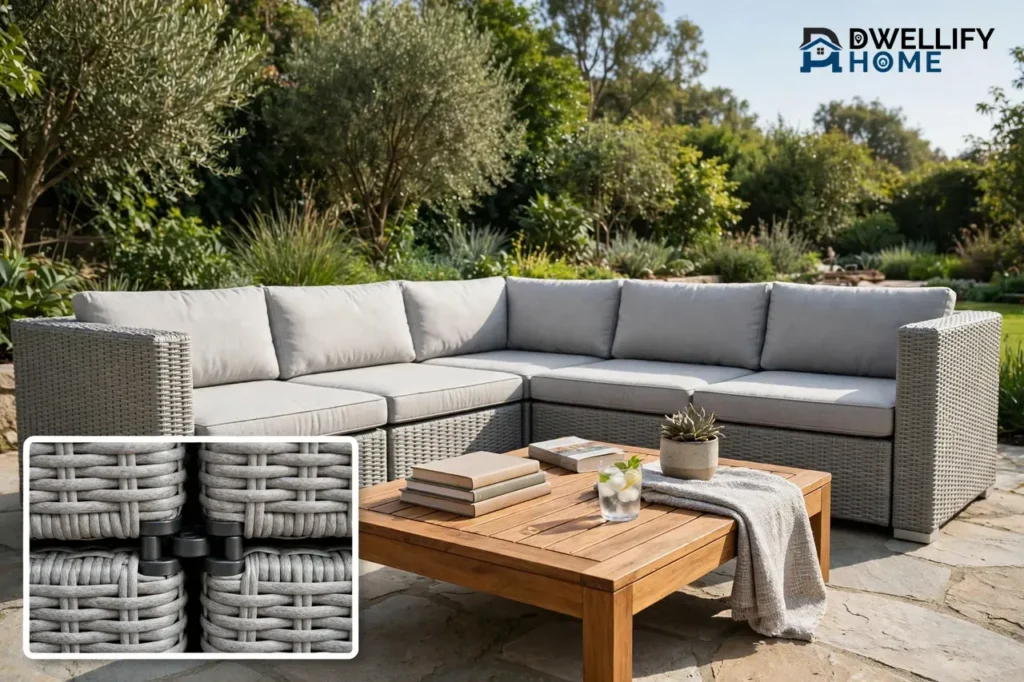
Modular outdoor furniture is a patio seating system sold as separate pieces — armless chairs, corner units, left-arm and right-arm end chairs, chaises, and ottomans — that clip together into any shape, so a 3-piece sofa today can become a 6-piece L-shaped sectional next summer without buying a new set. A starter set costs $2,500 to $4,000 for a small patio, and a large U-shaped layout runs $7,000 to $12,000. This guide explains the pieces, the layouts, the materials, and the buying traps, so you build a sectional that fits your space and still fits your life in three years.
One word on a product page decides whether you are buying modular furniture or an ordinary sectional, and most listings hide it in the small print. The test is in the pieces section below, and it takes thirty seconds to run before you spend a dollar.
What Is Modular Outdoor Furniture?
Modular outdoor furniture is a seating system made of independent pieces that you buy one at a time and arrange into any layout. Each piece is a complete seat on its own: an armless chair, a corner piece, a left-arm chair, a right-arm chair, a chaise, or an ottoman. The pieces connect with clips, pins, or straps, and you can pull them apart and rebuild the layout whenever you want.
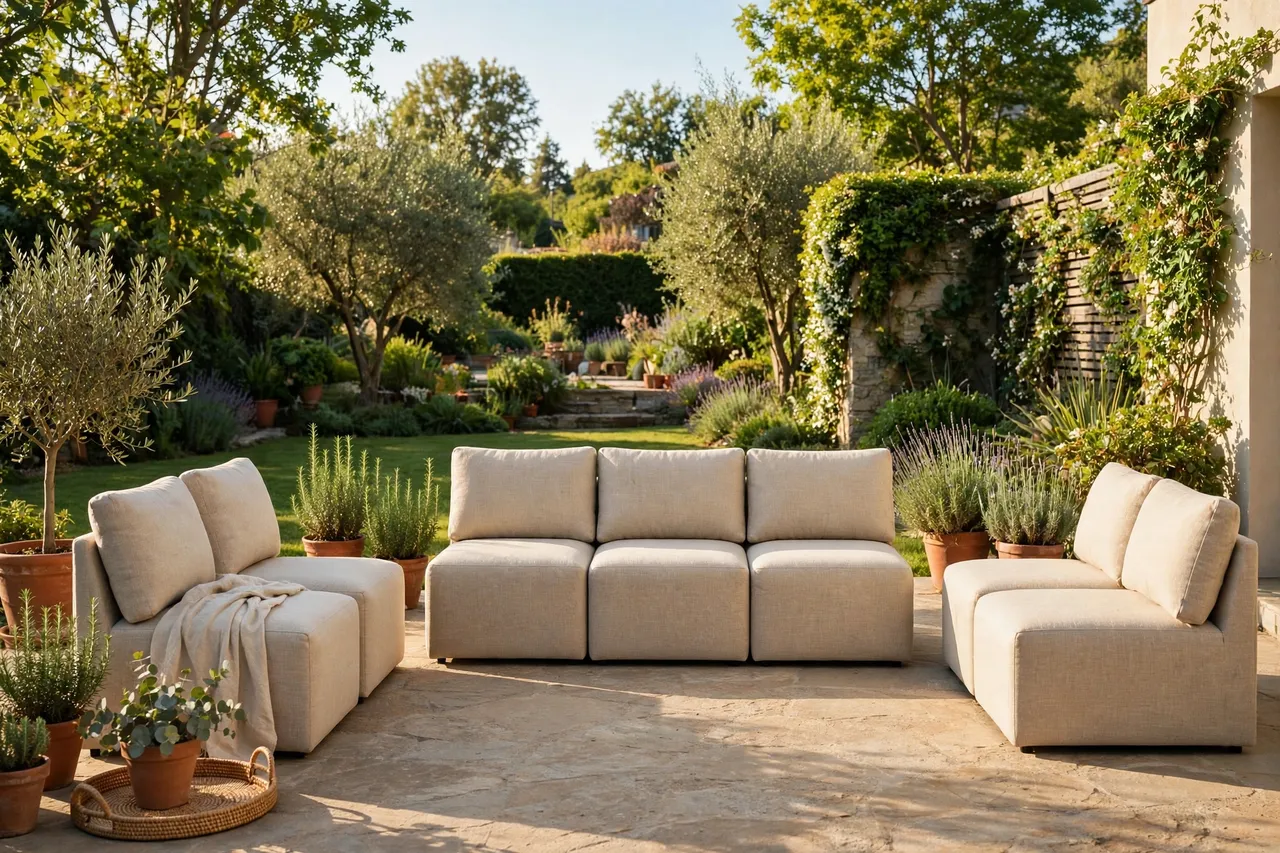
That independence is the whole point, and it is also the test that separates real modular furniture from marketing. A true modular system sells every piece individually. If a brand calls a set “modular” but only sells it as one bundled set, it is a sectional, not a modular system, and you cannot add a piece next year. The modular outdoor sectional guide from Kingmake states the rule plainly: check whether individual pieces are available before buying, because a bundle-only set locks you into one layout forever.
Modular furniture differs from a fixed sectional in three ways. First, it grows: add an armless chair when the family grows, add a corner when you move to a bigger patio. Second, it moves: the same pieces make a straight sofa on a balcony and an L-shape in a backyard, so the furniture adapts to the home, not the other way around. Third, it repairs: a damaged piece is replaced alone, not the whole set, which is why modular systems last longer in real homes than fixed sets.
The trade-off is price and patience. A modular system costs more per seat than a fixed set, because each piece needs its own frame, connectors, and cushions. And you have to plan the layout yourself instead of buying a shape off the shelf. For most buyers, that trade is worth it, because the patio you have in three years is rarely the patio you have today.
The 6 Pieces Every Modular System Is Built From
Every modular outdoor system is built from six pieces: the armless chair, the corner unit, the left-arm chair, the right-arm chair, the chaise, and the ottoman. Learn these six and you can read any product page, any quote, and any layout diagram without guessing.
| Piece | Typical width | What it does |
|---|---|---|
| Armless chair | 28–35 inches | Extends a straight run |
| Corner unit | 35 × 35 inches | Turns the layout into an L or U |
| Left-arm chair | 28–35 inches | Caps the left end of a run |
| Right-arm chair | 28–35 inches | Caps the right end of a run |
| Chaise | 60–70 inches long | Adds full-length lounging |
| Ottoman | 30–40 inches square | Footrest, seat, or coffee table |
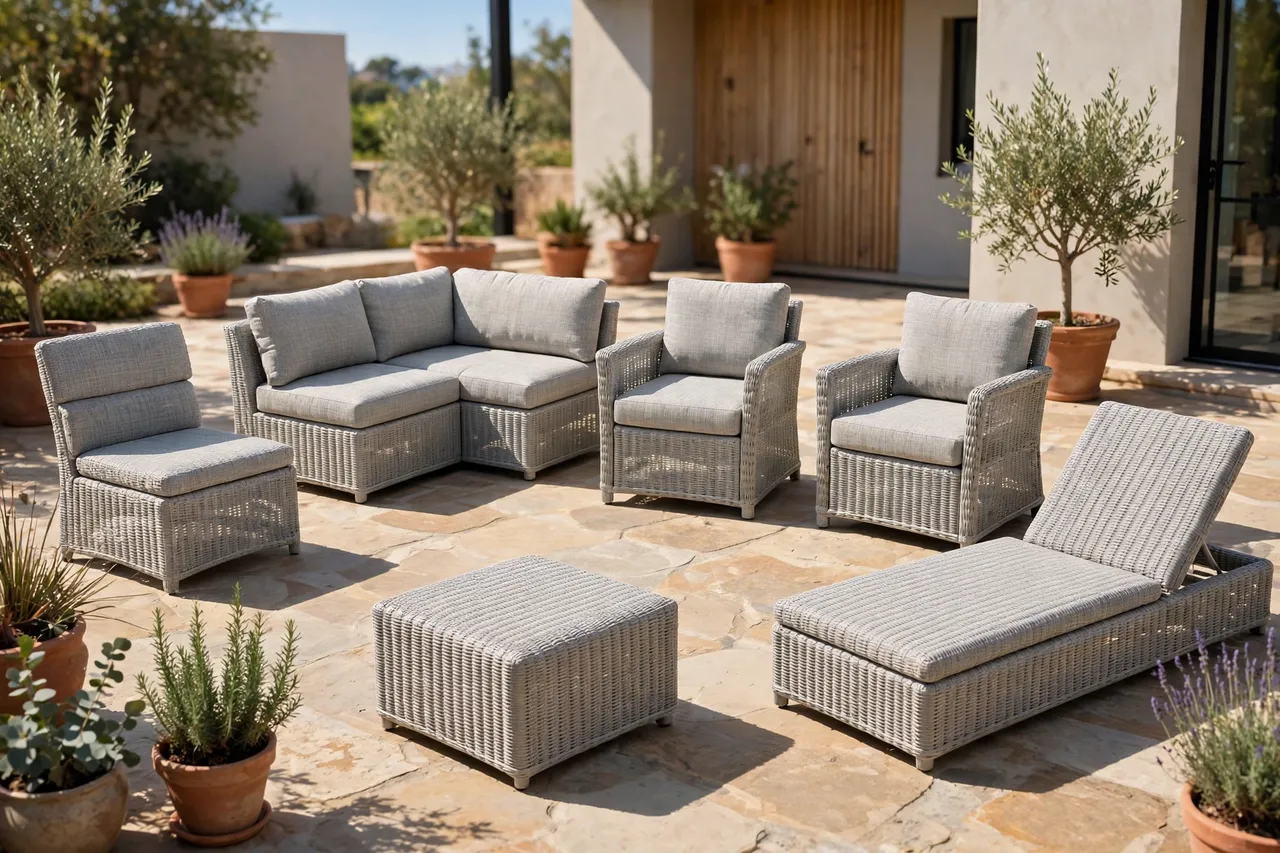
Armless chairs are the building blocks. They have no arms, so they slide between other pieces and extend a straight run by one seat at a time. A sofa grows by adding armless chairs, and it shrinks by removing them. If you buy one extra piece for the future, buy an armless chair, because it fits anywhere.
Corner units are the shape-changers. One corner turns a straight sofa into an L-shape. Two corners turn it into a U-shape. Corner pieces are larger than standard units, often around 35 inches square, and they cost more, so buy the corner with your first order if your plan includes one, because matching the fabric and finish later is harder than buying it now. Left-arm and right-arm chairs cap the ends of a straight run. They are mirror images and cannot be swapped, so check the convention before ordering: stand facing the sofa, and the arm on your left side is the left-arm facing chair, though some brands use the opposite rule.
The chaise adds a long seat for stretching out, and the ottoman is the most flexible piece of all: a footrest, an extra seat for a guest, or a coffee table with a tray on top. A console unit, available on some systems, adds a built-in side table between two seats for drinks and books. Our outdoor pouf ottoman guide covers the standalone version of that piece, and our outdoor coffee tables guide covers the table that usually sits in front of a modular sectional.
4 Layouts That Fit Real Patios
Four layouts cover almost every patio: the 3-piece straight sofa, the 4-piece L-shape, the 6-piece U-shape, and the curved conversation circle. Pick the layout by measuring your patio first, because a layout that looks right in a photo can swallow a small yard whole.
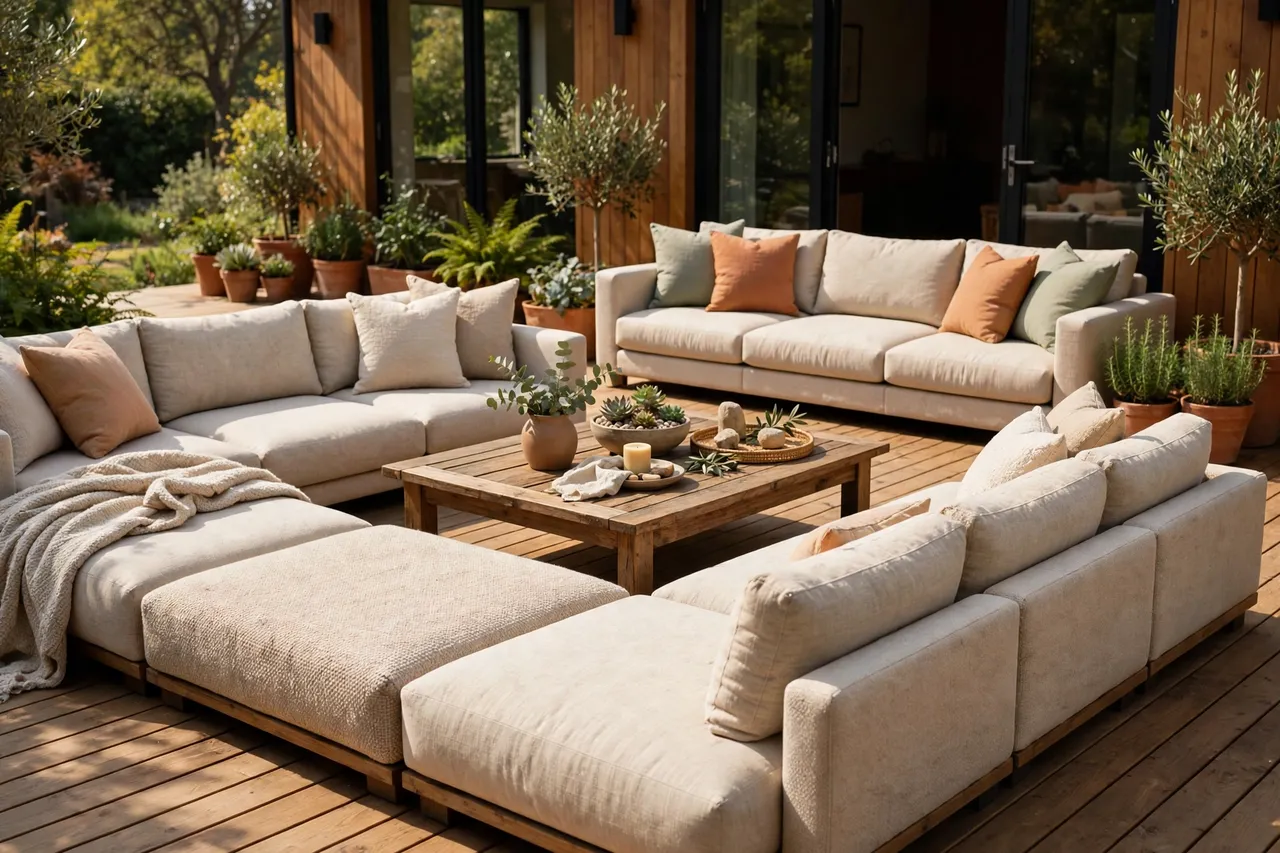
The straight sofa is the starter: a left-arm chair, an armless chair, and a right-arm chair, seating 3, and it fits a balcony at least 9 feet wide. It needs about 6 by 8 feet of floor, and it is the only layout that works on a narrow balcony. If your patio is under 100 square feet, start here and stop here.
The L-shape is the family standard: a left-arm chair, two armless chairs, and a corner unit, seating 4 to 5, and it fits a 12 by 14 foot patio. It tucks into a corner, leaves the middle of the patio open, and gives everyone a seat facing the same way, which is why it suits television, conversation, and the fire pit alike. Add an ottoman and it becomes a chaise for one lucky person.
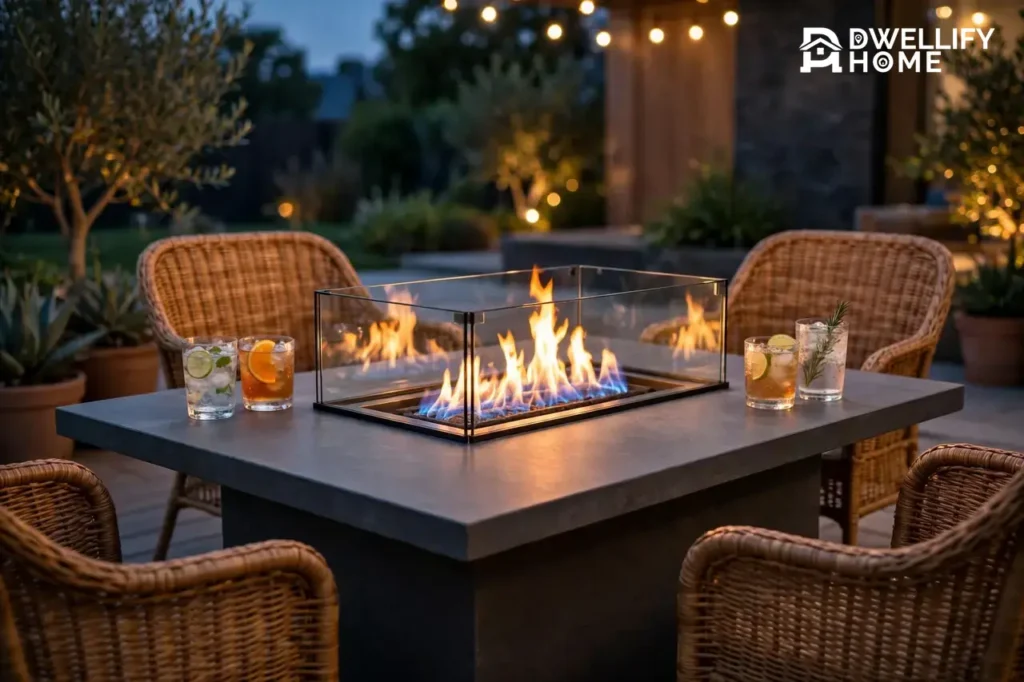
The U-shape is the entertainer: two corners and four or five seats, seating 6 to 8, and it needs a 16 by 20 foot patio or a large deck. It wraps around a coffee table and turns the patio into a room, but it eats space fast and it is hard to move through, so tape the outline on the ground before you order. The curved layout uses curved sections to make a circle or half-circle around a fire pit, and it suits social spaces where nobody wants a head-of-table seat. Our fire pit tables guide shows how a curved sectional and a fire table work together.
Plan the layout with one rule: about 24 inches of seat width per person, and 30 to 36 inches of walkway around the sectional. A layout that leaves no walkway is a layout nobody enjoys. Our outdoor furniture for small spaces guide shows how to fit a 3-piece modular sofa on a balcony without blocking the door, and our outdoor sectional couch guide covers the fixed sectional alternative if you want one shape and one price.
What Most People Get Wrong About Modular Furniture
Most people get one thing wrong about modular furniture: they buy a set that looks modular and discover too late that the pieces cannot be bought separately. The listing says “modular design,” the photos show three layouts, and the only thing for sale is one bundle. When a piece breaks or the family grows, there is nothing to add. Run the test before you buy: search the store for one armless chair in the same collection, and if it is not sold alone, the set is not modular.
The second wrong belief is that modular pieces stay put on their own. They do not. Unconnected pieces drift apart every time someone sits down, and a gap opens in the middle of the sofa. Check the connectors before you buy: metal clips hold best, embedded pins hold well, and fabric lashing straps loosen fastest. Ask the seller how the connectors hold up after a few seasons, because cheap connectors are the most common complaint on modular sets, and they are the hardest thing to fix after delivery.
The third wrong belief is that any fabric works outside. It does not. Indoor fabric on a modular sectional fades in one summer, holds water, and grows mildew. Outdoor fabric, solution-dyed acrylic or olefin, resists sun and water and dries fast. Check the cushion cores too: quick-dry foam drains water, while standard foam holds it like a sponge. A sectional with the wrong cushions is a sectional you cannot sit on after rain. Here is the problem with ordering online: the fabric that looks right on a screen can feel wrong in person, so order a swatch first, and the next section shows you what else to check before you pay.
How Much Does Modular Outdoor Furniture Cost?
Modular outdoor furniture costs $2,500 to $12,000 for a full layout, checked November 16, 2026, and the price follows the piece count, the frame, and the brand. A small 3-piece layout for an 8 by 10 foot patio runs $2,500 to $4,000. A medium 5 to 7 piece L-shape for a 12 by 14 foot patio runs $4,000 to $7,000. A large 8-piece U-shape for a 16 by 20 foot patio runs $7,000 to $12,000.
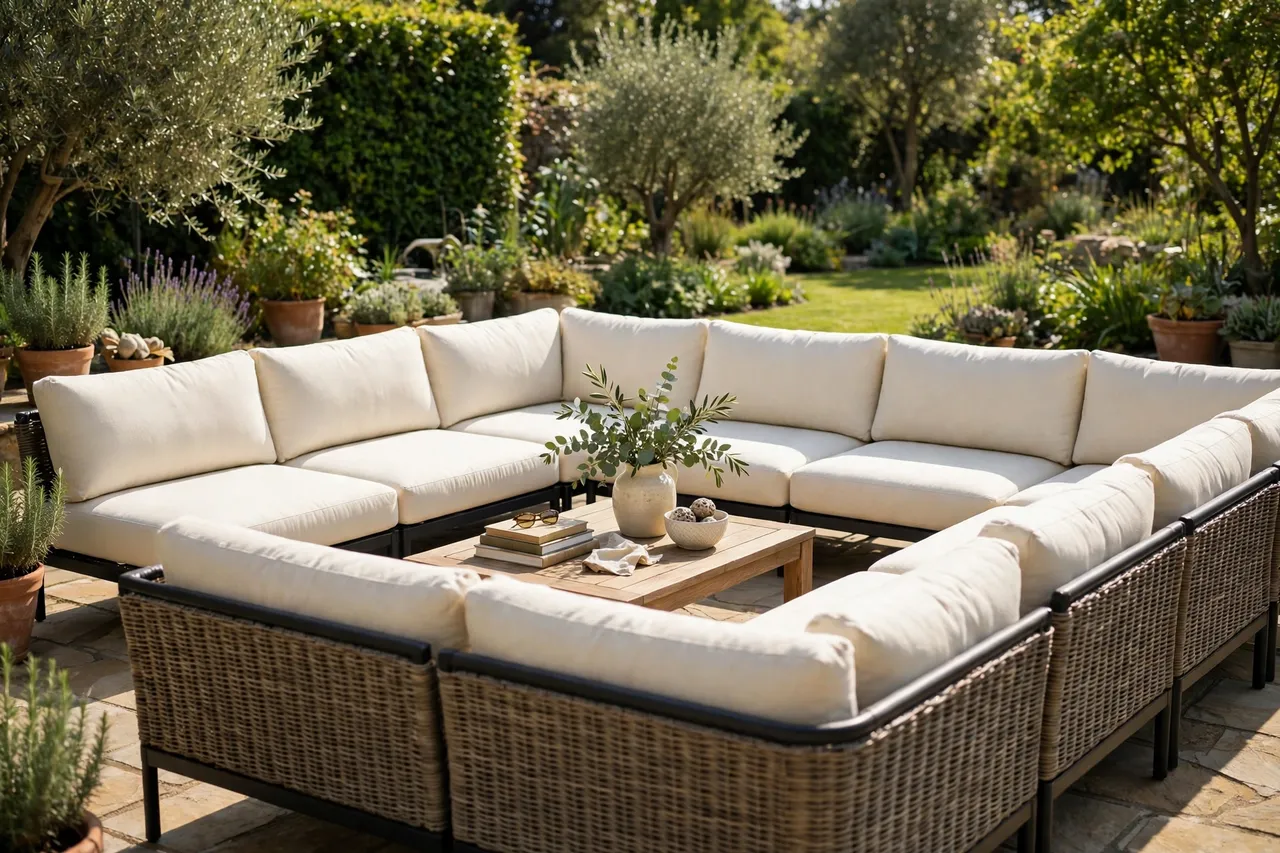
Piece prices show why modular costs more per seat than a fixed set. Corner sections run $826 to $1,637, single seats $1,214 to $1,944, loveseat sections $2,138 to $3,321, and end sections $1,321 to $1,655, according to the outdoor sectional guide from Loomlan, checked November 16, 2026. Each piece carries its own frame, connectors, and cushions, so the parts add up. The payoff is that you replace one piece, not the whole set, when something breaks.
Three things move the price most. First, the frame: powder-coated aluminum is the standard for exposed patios, teak costs more and suits covered spaces, and marine-grade polymer looks like painted aluminum and lasts 25 years or more. Second, the cushions: quick-dry foam with solution-dyed acrylic fabric costs more than standard foam with polyester, and it is worth every dollar outdoors. Third, the brand: American-made systems with long warranties cost more up front and less over a decade, because the parts are still available in five years.
Before you pay, ask the seller three questions in writing. Will you still make a single module in this finish and fabric two years from now? What is the warranty on the frame, the connectors, and the cushions, separately? And what does delivery include: placement, packaging removal, or just a box at the curb? A seller who answers all three clearly is a seller you can trust with a $5,000 order. A seller who cannot answer the first question is selling you a set that cannot grow, which is the opposite of modular.
Which Frame and Fabric Last Longest Outside?
Powder-coated aluminum frames with solution-dyed acrylic cushions last longest outside for most homeowners, at 15 to 25 years, because aluminum cannot rust and the fabric resists fading, water, and mildew. Teak frames last as long under cover but need oiling. Wicker over aluminum looks warm and lasts well, but the weave traps dirt. Steel frames are strong and cheap, but they rust at the first chip.
Aluminum is the default for a reason. It is light enough to rearrange, it never rusts, and a quality powder coat holds color for 10 to 15 years. Teak is the premium choice: it survives weather with almost no attention, it looks better with age, and it costs more than aluminum for the same seats. Our acacia wood furniture guide covers a warmer wood alternative at a lower price. Wicker, which is synthetic polyethylene woven over an aluminum or steel frame, gives the softest look and the most cleaning work, because dirt settles into the weave. Our wicker outdoor furniture guide covers it in full.
For cushions, the fabric matters more than the thickness. Solution-dyed acrylic, sold as Sunbrella and similar brands, holds color for years because the color runs through the fiber, not just on the surface. Olefin is the budget alternative: it resists water and fading well and costs less. Polyester fades fastest and holds water longest, so avoid it on a sectional that stays outside. The outdoor sectional guide from Decor Outdoor makes the same point: detachable or interlocking bases and quick-dry cushions are the features that decide whether a sectional stays comfortable after rain.
One more check: the cushion covers should come off for washing. Removable covers double the life of a sectional, because you wash the cover instead of replacing the cushion. If the covers do not come off, the first stain is permanent, and the first mildew smell never leaves. That one detail matters more than the cushion thickness, and the next section shows you how to keep the whole system alive.
How to Care for Modular Outdoor Furniture
Modular outdoor furniture needs about thirty minutes of care per season: wash the frames, clean the cushions, check the connectors, and tighten anything loose. The pieces make care easier, because you can pull the sectional apart and clean each piece properly instead of reaching around a fixed shape.
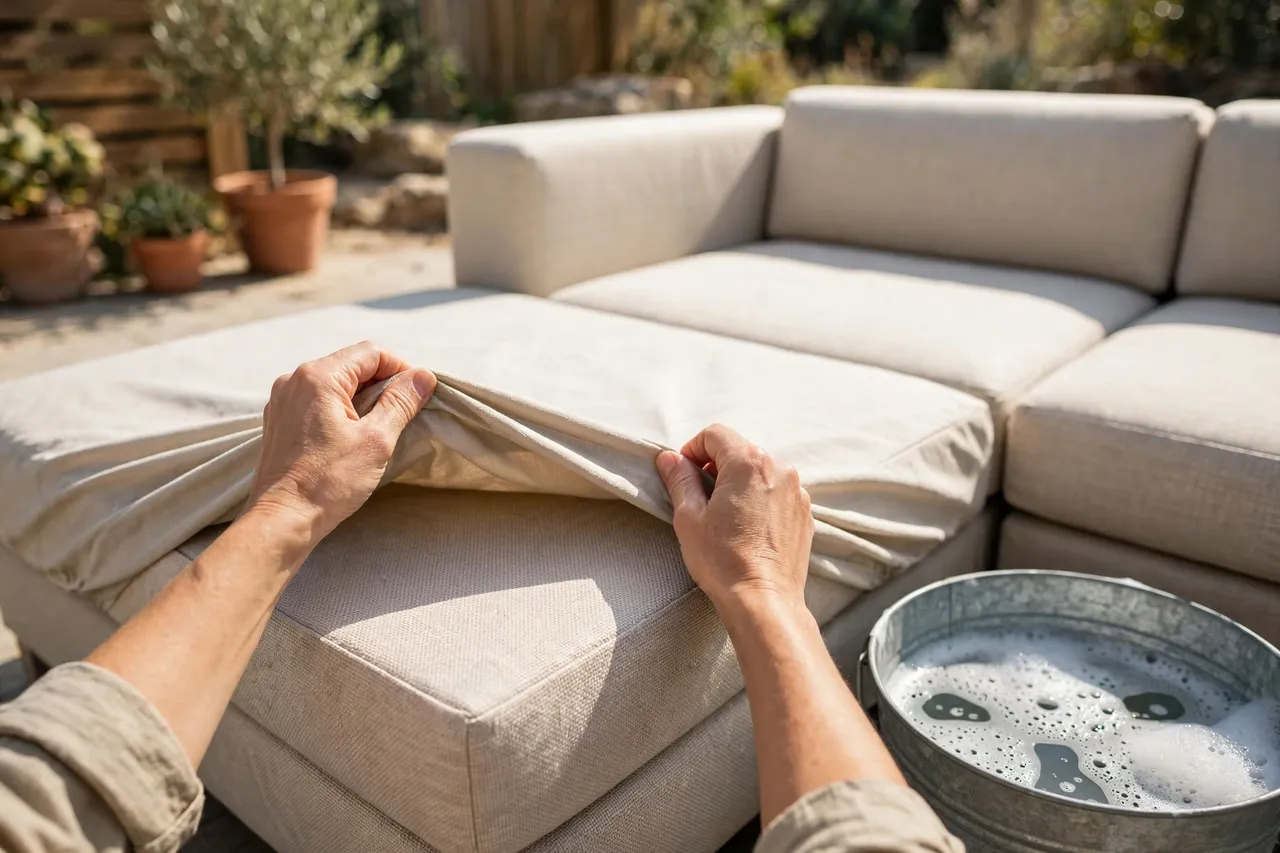
Start with the frames. Wash aluminum and wicker frames with mild dish soap and warm water, rinse with a hose, and dry in the sun. Touch up any paint chip on a steel frame the week you spot it. For teak, brush off dirt and let the wood silver naturally, or oil it once a year if you want to keep the warm color. Never use a pressure washer on wicker or cushions, because it tears the weave and forces water into the foam.
Next, the cushions. Remove the covers and wash them in cold water on a gentle cycle, then air-dry them completely before putting them back, because a damp cover grows mildew inside the cushion. Stand quick-dry foam cushions on their edge after rain so water drains out. Our replacement cushions for patio furniture guide shows how to measure and order new cushions when the old ones wear out, and it matters here, because modular cushions are sized per piece.
Then the connectors. Once a season, pull the pieces apart and check every clip, pin, and strap. Replace any clip that feels loose, because a loose connector lets the pieces drift and puts stress on the frames. Tighten any bolt at the feet, and check that the glides under each piece are still fitted, so the frames do not scratch the patio. For winter, the full routine lives in our guide on how to store outdoor furniture, and our outdoor covers for furniture guide covers which covers actually protect a sectional. The short version: clean every piece, dry the cushions fully, and either store them indoors or cover the set with a vented cover.
Modular vs Fixed Sectional: Which Should You Buy?
Buy a modular sectional when your space, your family, or your home is likely to change, because you can add pieces, rebuild the layout, and replace one damaged seat without buying a new set. Buy a fixed sectional when you want one shape, one price, and no planning, because a fixed set costs less per seat and arrives ready to sit on. The right pick depends on how certain you are about the next five years.
A fixed sectional wins on price and simplicity. It is one purchase, one delivery, and one shape that never drifts apart, because the pieces are bolted together at the factory. It loses on flexibility: it cannot grow, it cannot shrink, and it cannot move to a new home and fit a different patio. If you own your home, your patio is finished, and your family size is settled, a fixed sectional is the better buy.
A modular system wins on every kind of change. You move house, and the same pieces make a different shape. A child is born, and you add two armless chairs. A piece breaks, and you replace one seat. A corner of the patio gets a fire pit, and you rebuild the layout around it. The cost is higher per seat, and you have to plan the layout yourself, but the furniture outlives the plan you bought it for. For renters, movers, and growing families, modular is the only sensible choice.
One honest caveat: modular only works if the seller stays in business and keeps making your pieces. Before you buy, check how long the collection has been sold and whether the seller guarantees parts for at least five years. A modular system from a seller who disappears in a year is just an expensive fixed set. Ask the question, get the answer in writing, and then order with confidence.
Related Guides
If a modular sectional is on your list, these guides answer the next questions most owners ask. Start with our outdoor sectional couch guide to compare the fixed alternative, then read our outdoor pouf ottoman guide for the most flexible piece of all. Our outdoor coffee tables guide covers the table that anchors a sectional, and our lounger guide covers the chaise alternative. For the frame decision, see our metal outdoor furniture guide, and for the weather question, our weather-resistant outdoor furniture guide.
Frequently Asked Questions
What is a modular outdoor sectional?
A modular outdoor sectional is a seating system made of separate pieces — armless chairs, corner units, left-arm and right-arm end chairs, chaises, and ottomans — that you buy one at a time and clip together into any layout. Each piece is a complete seat on its own, so you can add pieces, rebuild the shape, and replace one damaged seat without buying a new set.
What is the difference between modular and sectional outdoor furniture?
Modular furniture sells every piece individually, so you can buy, add, and rearrange pieces one at a time. A sectional comes bundled as one set with a fixed shape, and you usually cannot buy single pieces. A true modular system lets you grow from a 3-piece sofa to a 6-piece L-shape later, while a sectional locks you into the shape you bought.
Can you buy modular outdoor furniture pieces separately?
Yes, if it is a true modular system, you can buy every piece separately: armless chairs, corner units, end chairs, chaises, and ottomans. That is the test of a real modular set. If a brand only sells one bundle, it is a sectional with modular marketing, not a modular system, so check the store for individual pieces before you order.
How much does modular outdoor furniture cost?
Modular outdoor furniture costs $2,500 to $12,000 for a full layout, checked November 16, 2026. A small 3-piece layout runs $2,500 to $4,000, a medium 5 to 7 piece L-shape runs $4,000 to $7,000, and a large 8-piece U-shape runs $7,000 to $12,000. Single pieces run $800 to $3,300 depending on the type, and the frame and cushion quality move the price most.
How do you arrange modular outdoor furniture?
You arrange modular outdoor furniture by measuring the patio first: start with the corner unit if you want an L-shape, add armless chairs to extend each run, and cap the ends with left-arm and right-arm chairs. Allow 24 inches of seat width per person and 30 to 36 inches of walkway around the set.
Does modular outdoor furniture stay together?
Modular outdoor furniture stays together when the connectors are good, and drifts apart when they are not. Metal clips hold best, embedded pins hold well, and fabric lashing straps loosen fastest. Check the connector type before you buy, inspect the clips every season, and replace any loose clip at once.
Modular outdoor furniture is the only patio seating that admits the truth: your life will change, and your furniture should change with it. Buy the pieces one at a time, buy the corner with the first order, and buy from a seller who will still make your pieces in two years. Do that, and the sectional you build this summer will still be the right shape in five summers.
Note: This guide gives general advice for choosing outdoor furniture. Measure your patio and check weight limits before you order, and get the parts guarantee in writing before you pay.