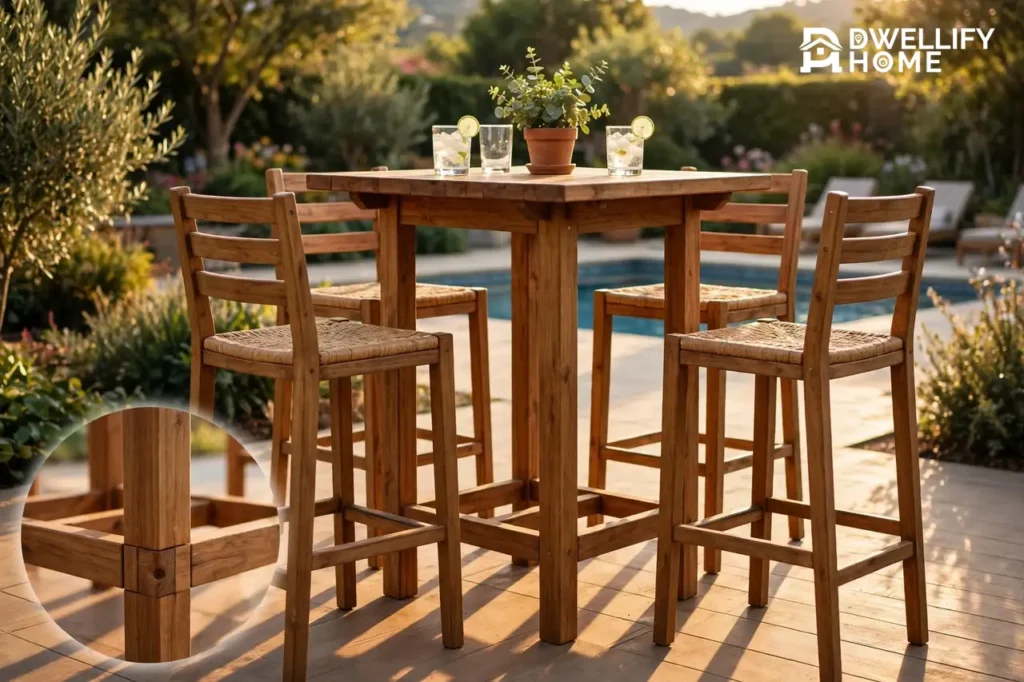
An outdoor bar table stands 40 to 42 inches high and pairs with bar stools 28 to 30 inches high, leaving a 10 to 12 inch gap between the seat and the tabletop so legs fit comfortably. That height is what turns a patio into a party spot: guests stand, mingle, and lean on the table instead of sitting down for a formal dinner. This guide covers bar height versus counter height, materials, real prices from $300 to $2,500, seating counts, and the placement tricks that make a bar table work.
One buying mistake ruins more bar tables than weather ever does, and it happens before the table even arrives. It sits in the mistakes section below, and most buyers make it because the table looks right in the photo. Before that, you need the height decision right, because a bar table at the wrong height is a table nobody uses.
What Is an Outdoor Bar Table?
An outdoor bar table is a tall table built for outdoor use, standing 40 to 42 inches high at bar height or 34 to 36 inches at counter height, designed for drinks, snacks, and standing conversation rather than formal dining. It pairs with tall stools, uses weather-resistant materials like teak, powder-coated aluminum, wicker, and resin, and fits patios, decks, balconies, and poolsides.
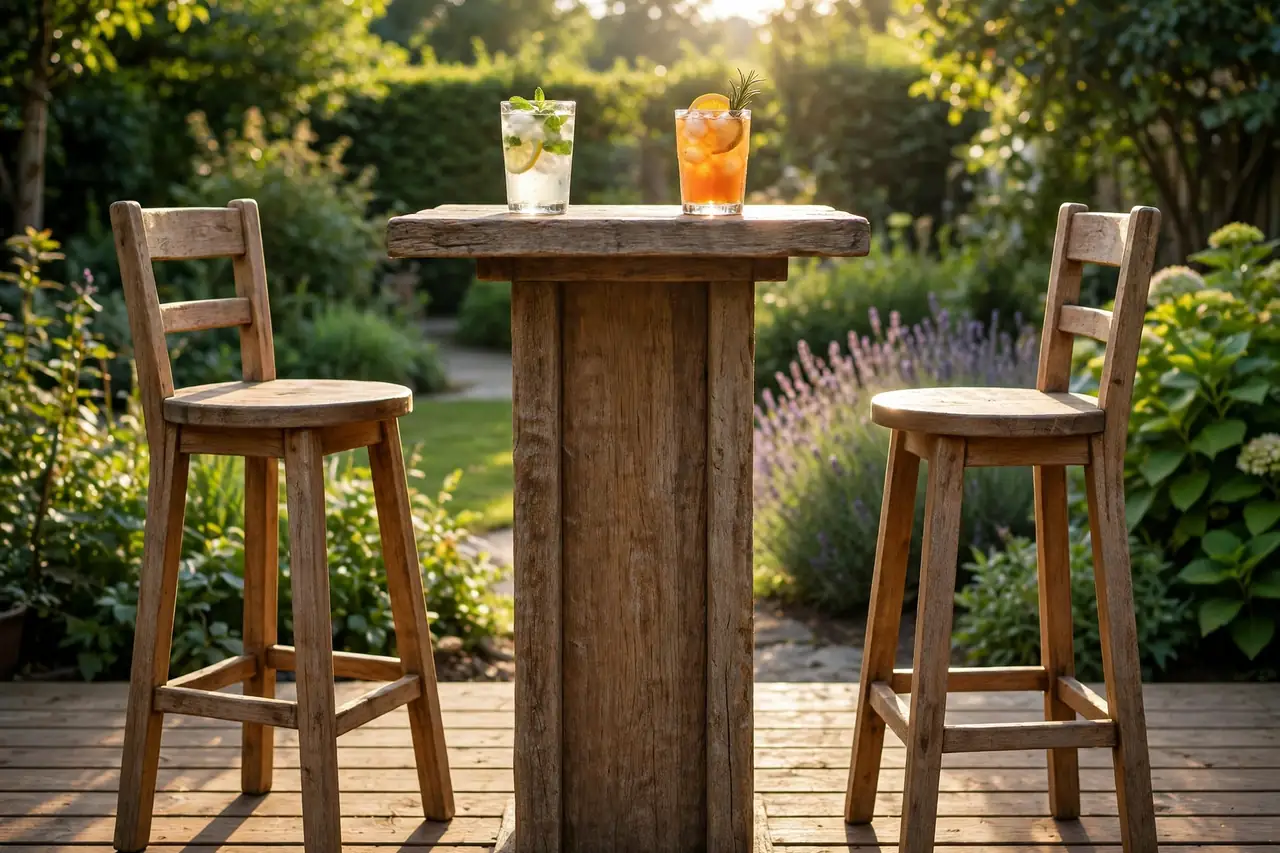
Unlike a standard dining table at 28 to 30 inches, a bar table encourages people to stand and mingle around it, which creates a more relaxed, cocktail-party atmosphere. The elevated surface also saves floor space: a tall table needs less room than a dining set for the same number of guests, and it lets people enjoy a garden or pool view over railings and foliage. Most bar sets seat two to six people, with the most common configurations being three-piece sets with two stools and a table, and five-piece sets with four stools and a table.
Outdoor bar tables come in three shapes. Round tables suit intimate gatherings of two to four, because everyone faces each other and nobody sits at a corner. Rectangular tables suit larger groups and double as serving stations, buffet tables, or prep space near the grill. Railing tables clamp onto a balcony rail and give a small balcony a bar without taking any floor space at all. If your patio is small, our outdoor furniture for small spaces guide shows seven layouts where a tall table earns its footprint.
A bar table is also more versatile than it looks. Use it as a dining surface for light meals, a drink station for a barbecue, a buffet table for a party, or even a standing workspace on a sunny morning. Many models add an umbrella hole for shade, a lower shelf for bottles, or a footrest rail that makes long sits comfortable. The table is the centerpiece of the entertaining zone, so pick it for how you actually host, not for how it looks empty.
Height makes it a bar table. Forty to forty-two inches, with stools 28 to 30 inches high.
Bar Height vs Counter Height vs Dining Height: Which One Fits Your Patio?
Bar height fits patios built for standing and socializing: the table stands 40 to 42 inches with stools 28 to 30 inches high. Counter height fits patios built for seated meals: the table stands 34 to 36 inches with stools 24 to 26 inches high. Dining height fits formal meals: the table stands 28 to 30 inches with chairs 16 to 18 inches high.
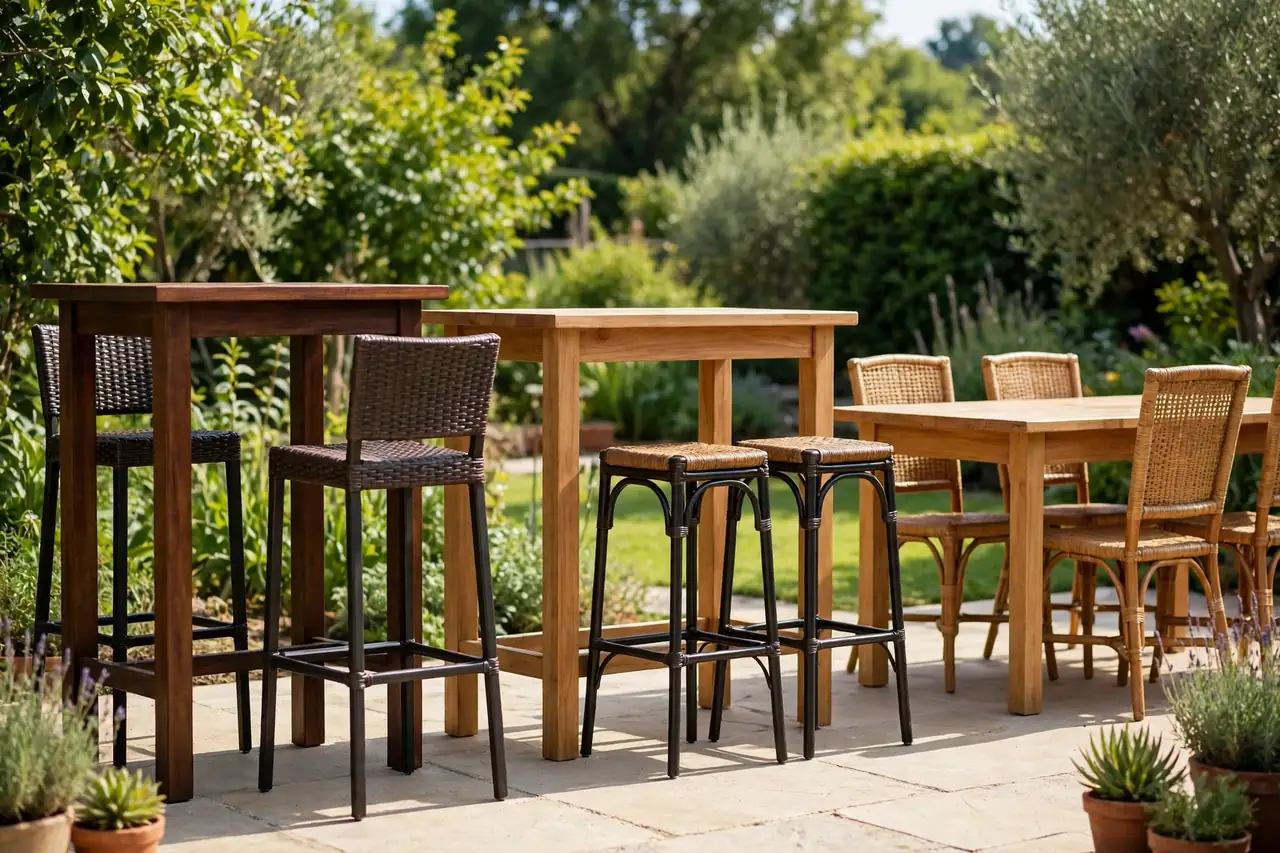
This is the single most important decision you will make, so here is the comparison in one place. Guess which height most buyers regret: the bar height they bought for family dinners, or the counter height they bought for cocktail parties? The answer is in the table, and it comes down to what you actually do at the table.
Table heights at a glance
| Height | Table height | Stool seat height | Best for |
|---|---|---|---|
| Bar height | 40–42 inches | 28–30 inches | Standing, drinks, parties |
| Counter height | 34–36 inches | 24–26 inches | Seated meals, everyday use |
| Pub height | 44–46 inches | 32–34 inches | Views, tall railings |
| Dining height | 28–30 inches | 16–18 inches | Full family dinners |
Height ranges in this table come from the outdoor bar table guide at Outdoor Furniture Atlas and the bar height guide at Homary, checked November 16, 2026. The critical measurement is the clearance between the top of the stool seat and the underside of the table: it should be 10 to 12 inches, so legs fit without bumping and arms rest naturally. A gap smaller than 10 inches cramps thighs, and a gap bigger than 12 inches leaves arms dangling. Read the full height breakdown at Homary’s outdoor bar height table guide.
Bar height delivers the most authentic pub-style experience, but it needs a footrest for comfort: at 40 inches, your feet need support or your legs tire in twenty minutes. Counter height is the better all-rounder: it works for seated dining, it is easier for kids and older guests to climb onto, and it pairs with the same stools you might use at a kitchen island. Pub height at 44 to 46 inches is less common, but it is great for views over a tall railing or a pool fence.
Match the stools to the table, never the other way around. If you already own stools, measure their seat height and buy the table that fits them: a 30-inch stool needs a 40 to 42 inch table, and a 24-inch stool needs a 34 to 36 inch table. If you are buying both, buy them as a set, because matched sets guarantee the 10 to 12 inch gap and the footrest height line up.
The 10 to 12 inch gap decides comfort. Measure the stools before you buy the table.
Which Material Holds Up Outside?
Powder-coated aluminum holds up best outside for most buyers, because it never rusts, it is light enough to move, and it handles rain, sun, and coastal air with a wipe. Teak lasts 25 years or more and looks warmer, but it costs two to three times as much, while resin wicker gives you the coziest look at a mid-range price.
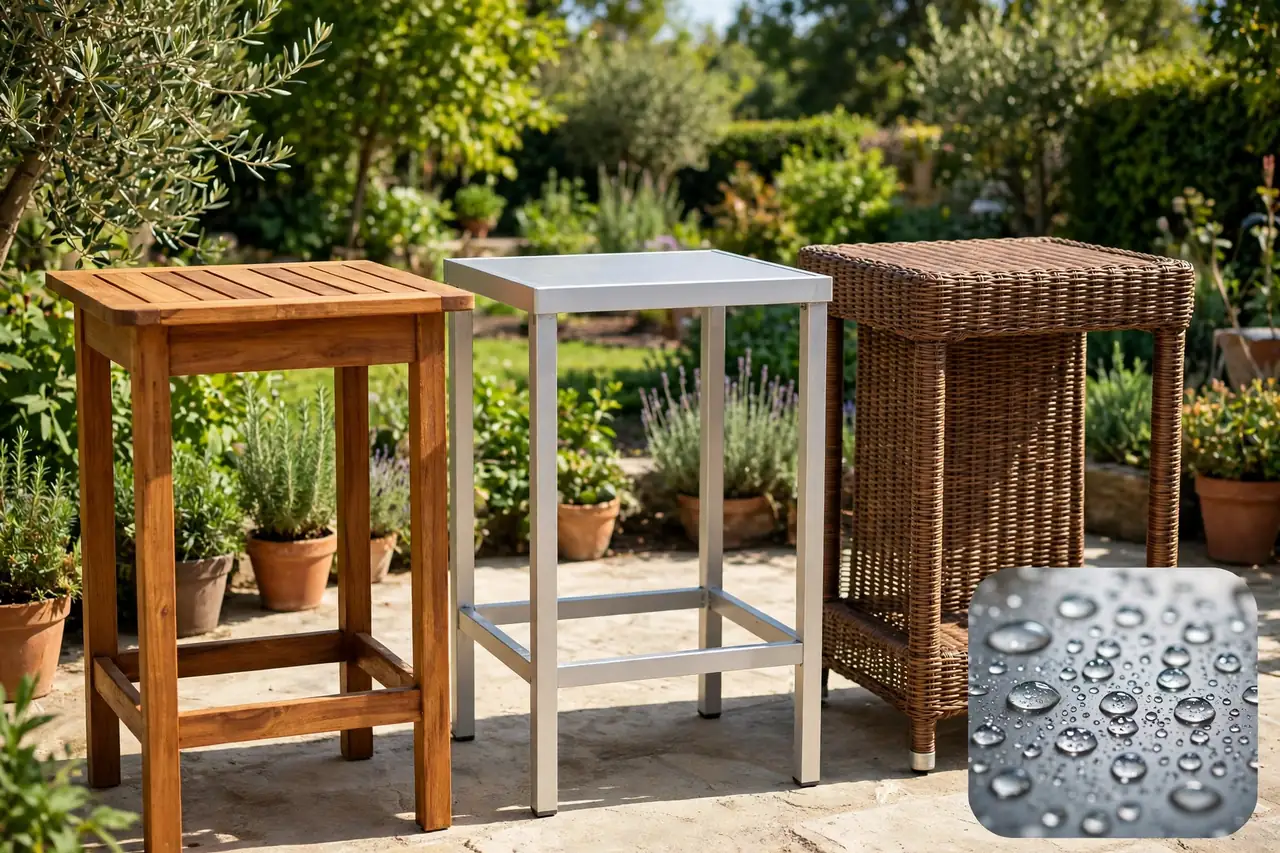
Material decides whether your bar table lasts five summers or twenty-five, so here is the honest comparison in one place. A teak bar table at $800 to $2,500 lasts 25 years or more, which is about $40 a year, while a cedar table at $200 to $700 lasts 10 to 15 years, which is about the same per year with more care. The cheap table is rarely the cheap choice.
Best outdoor bar table materials at a glance
| Material | Durability | Maintenance | Typical price |
|---|---|---|---|
| Teak wood | Excellent (25+ years) | Low (annual sealing optional) | $800–$2,500 |
| Powder-coated aluminum | Excellent (rust-proof) | Very low (wipe clean) | $300–$1,200 |
| Wicker / resin | Good (5–10 years) | Low (rinse with hose) | $250–$900 |
| Wrought iron | Very good (rust-prone if chipped) | Moderate (touch-up paint) | $400–$1,500 |
| Cedar / acacia | Good (10–15 years) | Moderate (seal annually) | $200–$700 |
Price and durability ranges in this table come from the outdoor bar table guide at Outdoor Furniture Atlas, checked November 16, 2026. Teak is the gold standard for wood, and powder-coated aluminum is the gold standard for metal: both survive year-round outside with minimal care, while wrought iron and acacia need more protection. See the full material breakdown at Outdoor Furniture Atlas’s outdoor bar table guide.
Teak earns its price honestly. Its natural oils fight rot and insects with no finish, it weathers to a silver-gray that most owners love, and a single coat of sealer each spring holds the honey color if you prefer it. Aluminum earns its price differently: it is light, so you can move the table to follow the shade, and it never stains a deck with rust. Wicker and resin suit traditional, cozy patios, but check that the weave is UV-stabilized polyethylene over a rust-proof frame, because natural wicker rots outside in a season.
Wrought iron and cedar are the two materials that punish neglect. Wrought iron is heavy and stable in wind, which is a real advantage for a tall table, but the moment the coating chips, rust starts, so touch up chips immediately. Cedar and acacia look warm and cost less, but they need annual sealing, and acacia in particular checks and cracks if you skip the oil. For a bar table that sits in full sun and rain with nobody to care for it, aluminum or teak are the only honest picks.
Aluminum for ease, teak for life. Everything else trades a lower price for a yearly habit.
How Much Does an Outdoor Bar Table Cost?
An outdoor bar table costs $75 to $2,500, with table-only models from $75 to $300, entry-level sets from $300 to $600, mid-range sets from $600 to $1,200, and premium teak sets from $1,200 to $2,500 or more, all checked November 16, 2026. A complete five-piece set with four stools usually runs $600 to $1,500.
The range is wide because the product is wide. A Tangkula acacia wood folding bar table lists at $74.99, which buys you a counter-height table for two, while a premium teak set with four stools can exceed $2,500. Entry-level sets around $300 suit occasional use on a covered patio, mid-range sets at $600 to $1,200 suit regular entertaining with better materials and sturdier stools, and premium sets suit buyers who want the table to outlast the patio itself.
Three things push the price up beyond the material. Stools add cost fast: a set with four stools costs roughly twice a set with two, and stools with backs, arms, and cushions cost more than backless ones. Size adds cost too: a 60-inch rectangular table that seats four costs more than a 32-inch round table that seats two, and a table with an umbrella hole, a lower shelf, or built-in storage costs more than a plain top. And joinery matters: a welded aluminum frame outlasts a bolted one through wind and winters, and it costs more to build.
Do not buy the table without pricing the stools. A $200 table with four $150 stools is an $800 purchase, not a $200 purchase, and a set that looks cheap can cost more than a matched set once you add seating. Buy table and stools together when you can: matched sets guarantee the heights line up, the footrests sit at the right height, and the style matches. See set configurations and prices at Outdoor Furniture Atlas’s outdoor bar set buying guide.
Price the stools with the table. The set is the purchase, not the tabletop.
How Many People Fit — and How Much Room Do You Need?
A 32 to 36 inch round outdoor bar table seats two to three people, a 40 to 48 inch round table seats four, and a rectangular table 60 inches long seats four to six, with 24 inches of table width per stool. Leave at least 24 to 30 inches of clearance around the table, plus 20 to 24 inches behind each stool for pull-out.
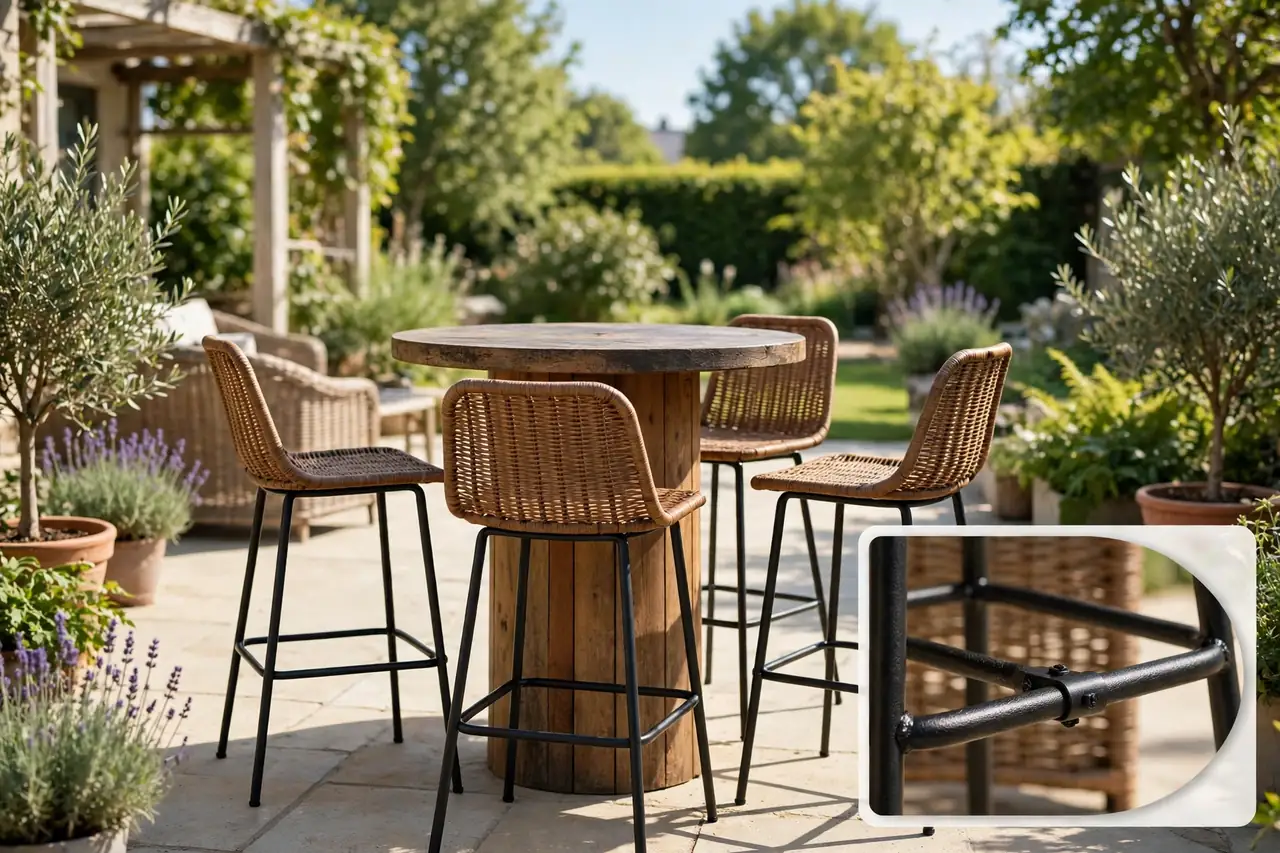
Seating math is simple once you know the two numbers. Each stool needs about 24 inches of table edge, so a 48-inch rectangular table seats two to three stools along one side, and a 60-inch table seats three to four. Round tables follow diameter: a 32-inch round seats two comfortably, a 36-inch seats two to three, and a 48-inch seats four. A four-seat round table needs a 48-inch diameter, and a six-seat rectangular table needs at least 60 inches in length.
Clearance is where most patios fail. A bar set needs more room than a dining set, because stools pull out and people step back to stand up. Allow 24 to 30 inches of clearance around the entire table for comfortable movement, and add 20 to 24 inches behind each stool for pull-out. Homary’s guide goes further: at least 36 inches of open space around every side for a walkway. Tape the full footprint — table plus stools pulled out — on the patio floor before you order, because a set that fits on paper can block the path to the grill in real life.
Space the stools properly. Leave about 24 to 26 inches between the centers of each stool, so elbows do not bump and nobody feels crowded. If the table sits against a wall or a railing, leave the open side for stools and keep the wall side clear: a rectangular bar table against a wall saves a foot of floor space and still seats three. If your evenings run late, pair the table with a propane patio heater so the bar area stays usable after sunset, and read our patio dining set guide if the same patio also needs a dining table, so the two do not fight for space.
Tape the pulled-out footprint, not the tabletop. Stools need room to move, and people need room to stand.
What Most People Get Wrong About Bar Tables
Most people get outdoor bar tables wrong in three ways: they buy a beautiful table without confirming the stool height, they buy stools without footrests, and they buy a light table for a windy patio. All three mistakes cost money, and the first one is the most common.
The stool-height mistake is the big one. A 40-inch table with 24-inch counter stools leaves a 16-inch gap that makes every meal feel like eating at a shelf, and a 36-inch table with 30-inch bar stools leaves a 6-inch gap that cramps every thigh. The fix is a tape measure: confirm your stools are 28 to 30 inches high for a bar table, or 24 to 26 inches for a counter table, before you click buy. If you are replacing a table and keeping the stools, stick with the same height range.
The footrest mistake runs the other way: bar stools without footrests are a comfort disaster. At bar height, your feet need support to prevent leg fatigue, and twenty minutes without a footrest feels like an hour. Choose stools with a built-in footrest rail, or buy a table with a footrest ring, and choose stools with backrests if you plan to linger over drinks. A backless stool is fine for a quick drink, and a misery for a long evening.
The wind mistake is the quiet killer. A tall, light aluminum table catches wind like a sail, and one gust can flip it into the pool or across the patio. If your patio is windy, pick a heavy base, a wrought iron frame, or a table you can weigh down, and never leave a light bar table uncovered in a storm. A table that blows over once usually does it again.
Measure the stools, demand a footrest, respect the wind. Three checks before you buy.
Where to Put It and How to Style It
Put an outdoor bar table where people naturally gather: near the grill as a prep and serving station, poolside as a drink station, against a wall or railing to save space, or under an umbrella for shade. Style it with a tray, a candle, and a small plant, and keep the surface clear enough for glasses.
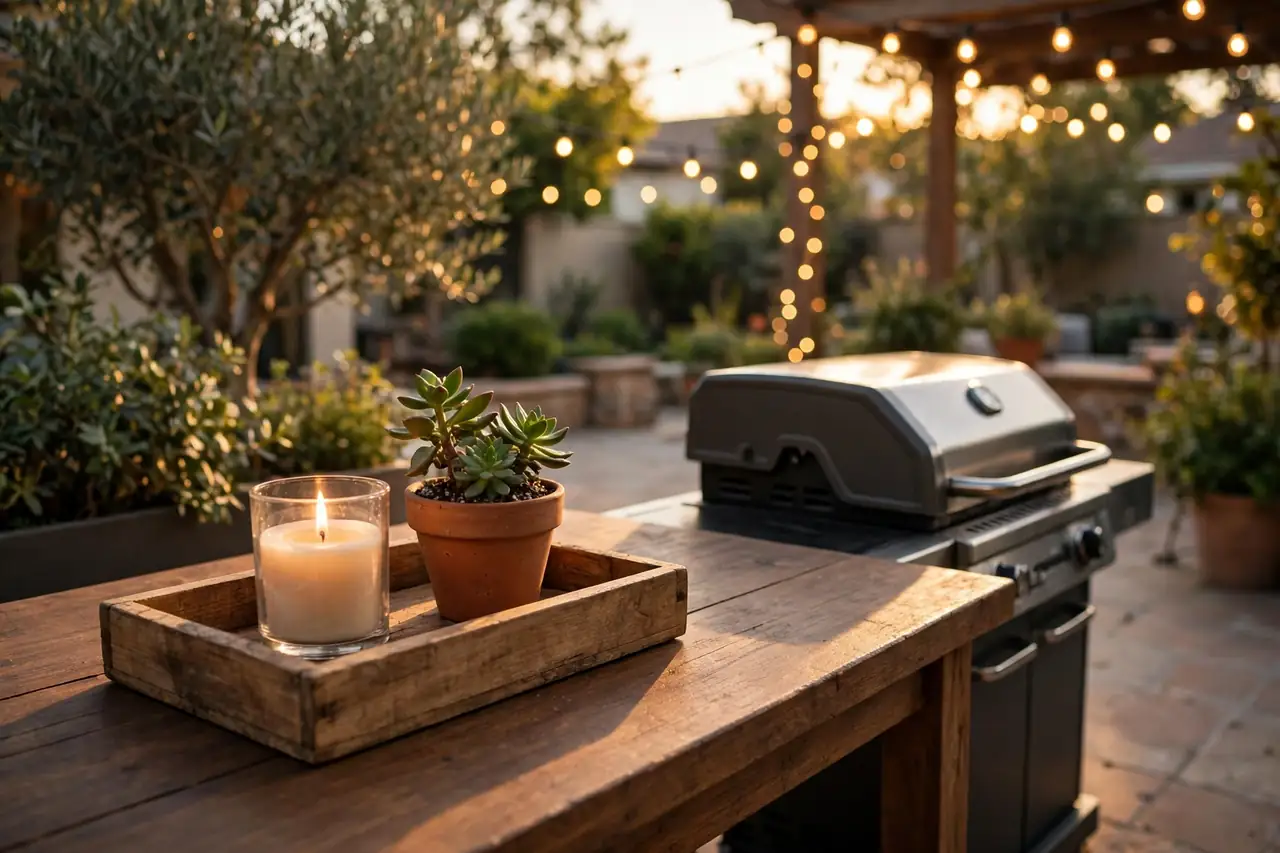
Near the grill is the hardest-working spot. A bar table within arm’s reach of the cooking area holds plates, sauces, and drinks while the cook works, and guests gather there instead of crowding the grill. Poolside, a bar table works as a drink station and towel holder: choose rust-proof materials like aluminum or resin, because chlorine and splash punish steel and wood. Against a wall or railing, a rectangular table saves space and still seats three on the open side, which is the best use of a narrow balcony.
Shade decides whether the table gets used at noon. Pair the table with a round outdoor umbrella or a cantilever style, and check that the umbrella hole fits your umbrella pole: most bar tables take a 1.5 to 2 inch pole, and a pole that is too thick will not fit. If the table sits in full afternoon sun, our patio shade ideas guide and our sunshade for patio guide show shade options that work with tall tables. In the evening, string lights or solar pathway lights around the bar area turn it into the place everyone drifts toward.
Style it lightly. A tray, a candle, and a small plant layer the surface without cluttering it, and a tray keeps glasses from sliding on a slatted top. Do not overload the table: a bar table is a working surface, and every decoration is one less glass it can hold. In winter, cover the table or move it under shelter, and follow the seasonal routine in our how to store outdoor furniture guide, because teak, aluminum, and resin can stay out year-round, while wrought iron and acacia need more protection.
Put it where people already stand. The grill, the pool, and the view decide the spot.
Related Guides
If you are planning the whole outdoor space, these guides pick up where this one leaves off:
- Patio Dining Set — size a dining table so it does not fight your bar table.
- Outdoor Furniture for Small Spaces — seven layouts that make a tiny patio feel big.
- Propane Patio Heater — stretch the season after the sun goes down.
- Electric Patio Heater — warm the bar area without a gas tank.
- Patio Shade Ideas — keep the bar area cool at noon.
- Sunshade for Patio — shade options that work with tall tables.
- How to Store Outdoor Furniture — keep it clean, dry, and ready for spring.
- Small Patio Decorating Ideas — make a small space feel finished, not crowded.
Frequently Asked Questions
What height should an outdoor bar table be?
Standard bar height is 40–42 inches, paired with 28–30 inch stools. Counter height is 34–36 inches with 24–26 inch stools. Choose based on whether you prefer standing or seated comfort, and keep a 10 to 12 inch gap between the stool seat and the tabletop.
Can I leave my outdoor bar table outside all year?
It depends on the material. Teak, aluminum, and resin can stay out year-round with minimal care. Wrought iron and acacia need more protection, and in harsh winters, storing or covering is recommended for every material.
How many people fit at a round outdoor bar table?
A 32-inch round table seats 2 comfortably, a 36-inch seats 2–3, and a 48-inch seats 4. Rectangular tables seat 4–6 depending on length, with about 24 inches of table edge per stool.
What’s better: wood or metal for an outdoor bar table?
Wood offers warmth and natural beauty, while metal is lighter and lower maintenance. Teak is the gold standard for wood, and powder-coated aluminum is the gold standard for metal. Choose wood for looks and metal for ease.
Do I need special cushions for bar stools?
Yes — use waterproof outdoor seat cushions designed for high-backed bar stools. They resist mold and retain their shape better than indoor cushions, and they should be stored indoors during heavy rain.
Disclaimer: This guide gives general advice for choosing and placing outdoor furniture, not professional safety or structural instructions. Check weight limits before leaning or sitting on a table, anchor light tables in windy spots, and follow the manufacturer’s care instructions for your material.
Measure the stools, pick the height, then buy the set. Forty to forty-two inches, a 10 to 12 inch gap, a footrest on every stool, and a material that matches your weather. Do that, and the table you buy this year is still the place everyone gathers ten summers from now.