A thermostat heat pump setup works best when the thermostat truly understands the heat pump. A heat pump needs a thermostat that can switch the system between heating and cooling, manage backup heat, and warm your home slowly instead of in big jumps. A regular furnace thermostat cannot do those jobs, and the wrong one can run expensive backup heat far more than needed. This guide explains how a thermostat for a heat pump behaves, what aux and emergency heat mean, which settings to use, and what to check before you buy.
Here is the short version. Keep a steady temperature, change it in small steps of 1 to 3 degrees, and let the heat pump do the work. Save the deep overnight setbacks for a furnace. If you want the details, keep reading: every section below answers one question a heat pump owner actually asks.
💡 Practical Home Tip: Before you change any setting or buy a new thermostat, take a clear photo of the wires on your old thermostat with the terminal letters showing. That one photo saves you from guessing later, and it is the first thing any HVAC technician will ask to see.
What a Heat Pump Thermostat Does Differently
A heat pump thermostat does more than turn heat on and off. A heat pump is one outdoor unit that both heats and cools your home. It moves heat instead of making it. In winter, it pulls heat from outdoor air and moves it inside. In summer, it reverses and moves heat outside, just like an air conditioner. The U.S. Department of Energy says heat pumps can cut electricity use for heating by about 50% compared with electric resistance heating, and that is why the thermostat’s job matters so much: it protects that efficiency.
The thermostat controls this two-way job through a reversing valve. A wire on the O or B terminal tells the valve which way to run. Most brands, including Carrier, Trane, and Lennox, energize the valve in cooling mode with the O wire. Rheem and Ruud energize it in heating mode with the B wire. Get O and B backward and the system heats when you ask for cooling. That is the single most common heat pump thermostat mistake, and it is why our thermostat wiring guide tells you to match the terminal letters on your old thermostat, not the wire colors.
A heat pump thermostat also manages the compressor in stages. On a single-stage system, the compressor is either on or off. On a two-stage system, the thermostat runs the first stage for mild days and adds the second stage only when the house needs more heat or cooling. Variable-speed systems go further and adjust output in small steps. The thermostat must support the number of stages your system has, or the system cannot use its best features.
Heat pump air also feels different from furnace air, and that surprises many new owners. A furnace blasts air at about 120 degrees, while a heat pump delivers air between 90 and 100 degrees. The air still warms the house, but it feels cooler at the vent and takes longer. A heat pump thermostat knows this, so it starts heating earlier and runs longer, steadier cycles instead of short, hot blasts.
Aux Heat vs Emergency Heat: What Each One Means
Aux heat and emergency heat sound alike, but they do opposite jobs. Aux heat is automatic. Your thermostat turns it on by itself when the heat pump needs help. Emergency heat is manual. You switch it on by hand, and it turns the heat pump off. Mixing them up is the most expensive mistake a heat pump owner can make, so learn the difference now.
Most backup heat is a set of electric heat strips inside the indoor air handler. Lennox describes it as electric resistance heating, similar to how a space heater or a toaster works. The strips make heat directly from electricity, which is simple and reliable but costly. Google’s own help page says aux heat can cost about 2 to 5 times as much as running your heat pump, so every minute the strips run matters to your bill.
| Setting | What runs | Who turns it on | Cost to run |
|---|---|---|---|
| Heat | Heat pump only | You pick the mode | Lowest |
| Aux heat | Heat pump plus heat strips | Thermostat, automatically | Higher, for short periods |
| Emergency heat | Heat strips only, heat pump off | You, by hand | Highest |
Aux heat turns on in three normal situations. First, when outdoor temperatures drop very low and the heat pump cannot keep up alone. Second, during a defrost cycle, when the heat pump briefly reverses to melt frost off the outdoor coil and the strips keep warm air coming. Third, when you raise the thermostat by more than 3 or 4 degrees at once and the thermostat calls for extra power to close the gap fast. Trane says the thermostat calls for aux heat when it is below about 40°F outside, during defrost, or when you raise the temperature by more than 3 or 4 degrees. Seeing AUX on a cold morning is normal. Seeing it all day in mild weather is not.
Emergency heat is only for a real breakdown. Rheem’s owner manual says emergency heat is a backup heating mode to use only if you suspect a problem with the outdoor unit. Lennox lists the same rule: use it when the heat pump has completely failed. Switch to emergency heat when the outdoor unit is not running, is damaged, or is frozen solid, and then call a technician. Do not leave the thermostat on emergency heat after the repair. It runs the strips alone, and your bill will show it.
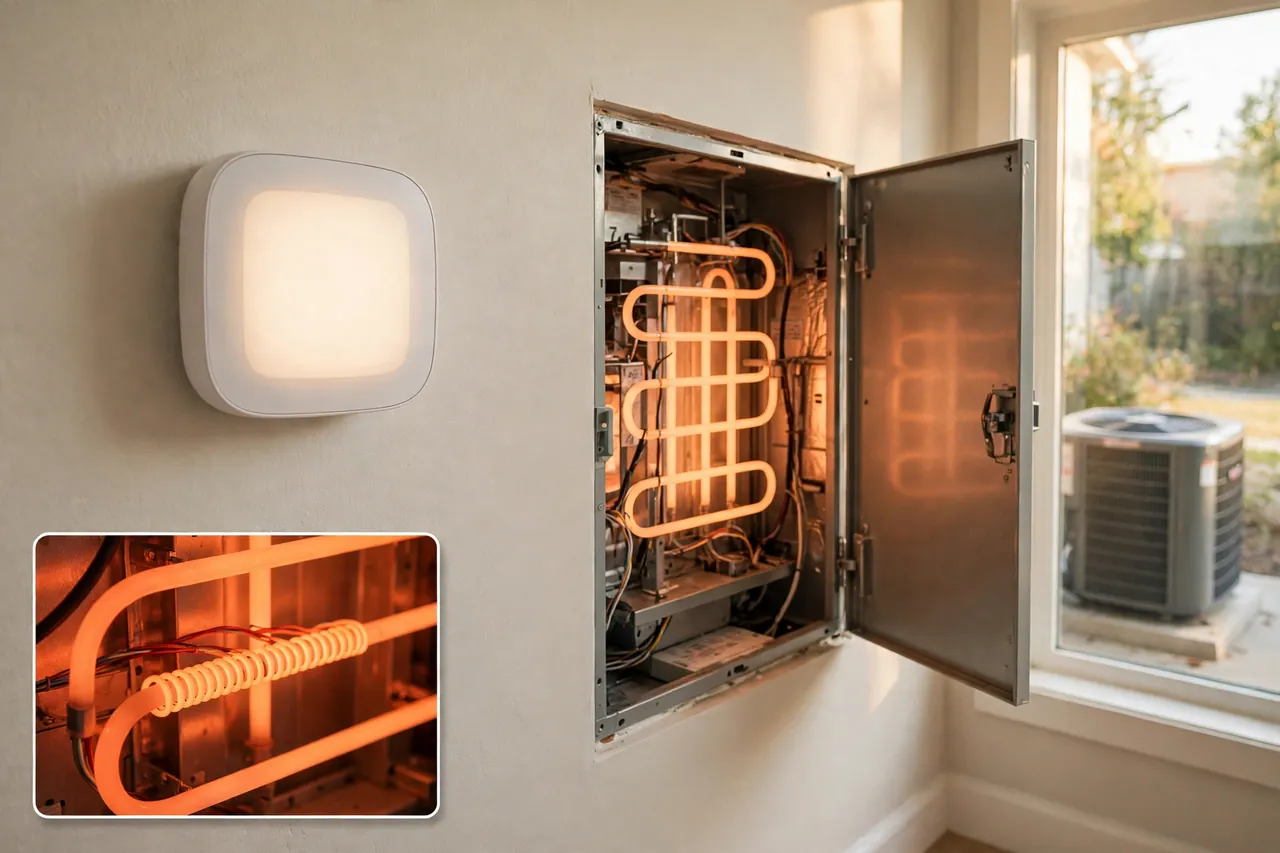
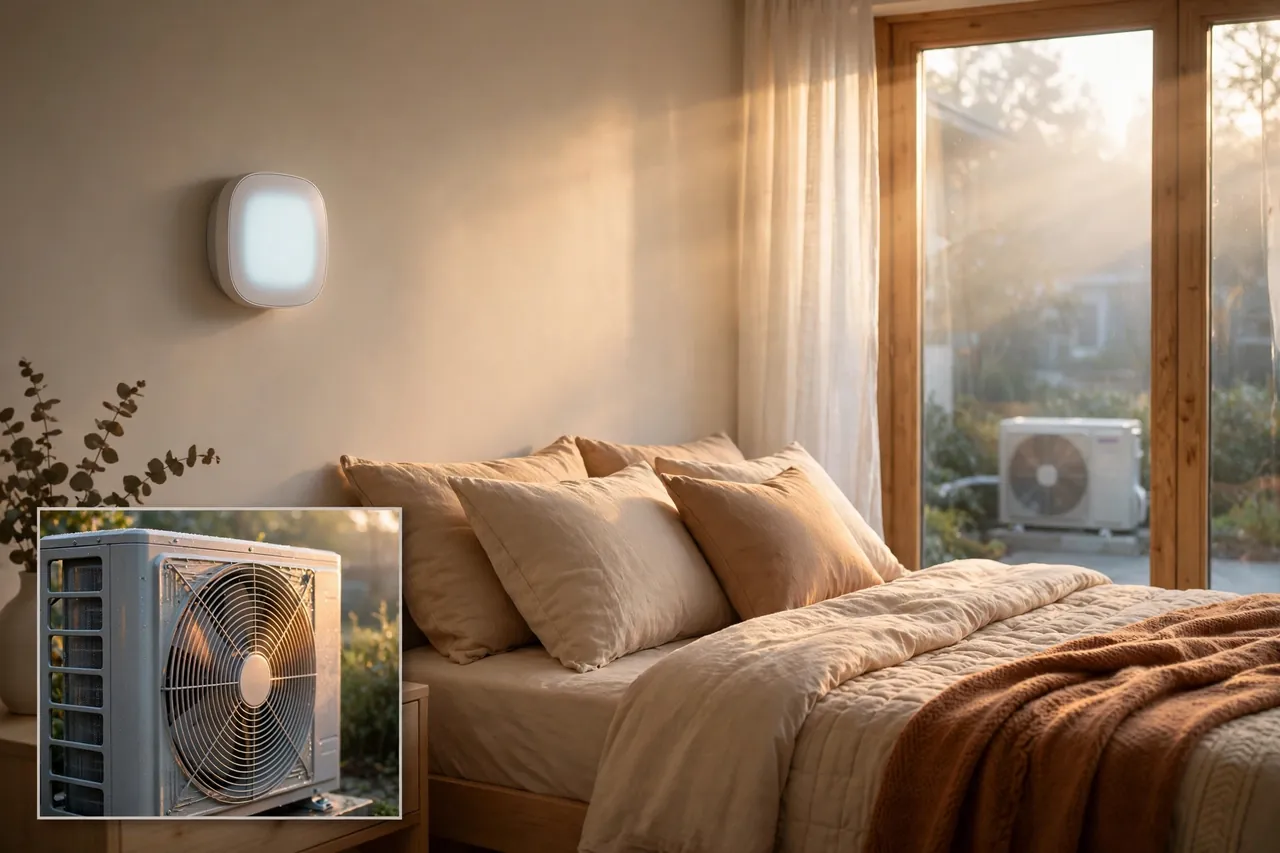
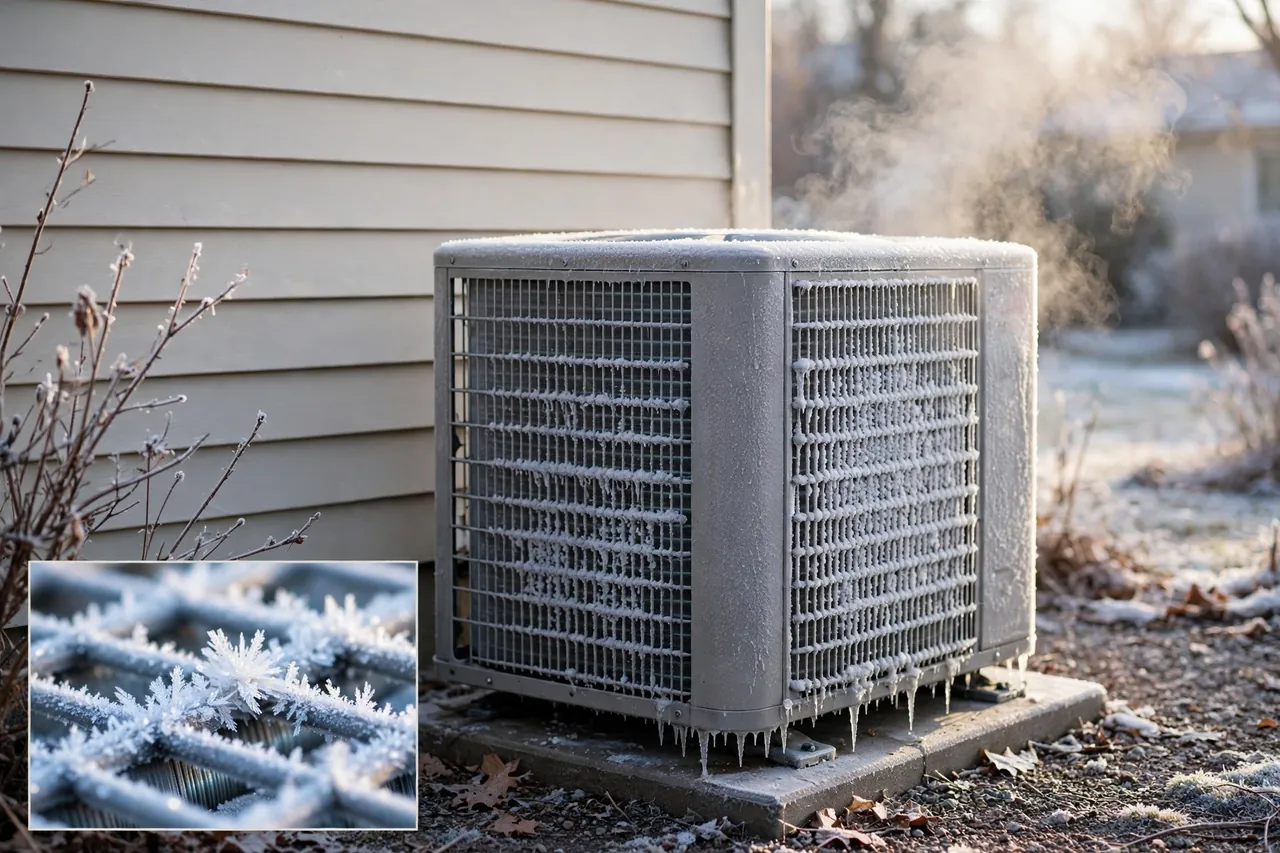
A defrost cycle deserves a quick note because it worries new owners. On a cold day, frost builds up on the outdoor coil. The heat pump melts it by briefly reversing into cooling mode. You may see steam rise from the outdoor unit and feel slightly cooler air from the vents for 5 to 10 minutes. That is normal. Do not switch to emergency heat because of steam or frost. If the whole outdoor unit is a solid block of ice, that is different: switch to emergency heat for warmth and call a technician. For a deeper look at emergency heat on its own, read our em heat vs heat guide.
The Best Heat Pump Thermostat Settings for Winter
The best heat pump thermostat settings for winter are simple: pick a comfortable temperature, use Heat mode, and leave the fan on Auto. Start around 68°F while you are home and awake. That is the starting point the U.S. Department of Energy recommends, and the New York State Energy Research and Development Authority (NYSERDA) gives the same 68°F starting point. Adjust up or down one degree at a time until the house feels right. In summer, start around 75°F to 78°F and pick the warmest setting that still feels comfortable.
| Setting | Recommended choice | Why it matters |
|---|---|---|
| Mode | Heat in winter, Cool in summer | Stops unwanted switching between modes |
| Winter temperature | 68°F to 70°F while home | Comfortable starting point for most homes |
| Summer temperature | 75°F to 78°F while home | Highest comfortable setting saves energy |
| Fan | Auto | Runs only during heating or cooling |
| Night and away | Steady, or 1 to 3°F lower | Avoids triggering aux heat on recovery |
| Emergency heat | Off during normal use | Reserved for a failed outdoor unit |
Use Heat mode through the whole heating season, not Auto mode. Auto mode lets the thermostat switch between heating and cooling on its own, and on a mild day it can flip back and forth and waste energy. Heat mode keeps the decision simple. The same goes for summer: use Cool mode, not Auto.
Keep the fan on Auto, too. A fan set to On runs all the time, even when the system is not heating or cooling. In summer, that pulls warm, humid air across the indoor coil and makes the house feel muggy. In winter, it blows room-temperature air that feels like a draft. Auto runs the fan only during active heating or cooling cycles, and your home stays drier and more comfortable.
One more winter habit pays off: do not turn the system off when you leave for a few hours. Coming home to a cold house forces a big recovery, and a big recovery is exactly what triggers aux heat. A small setback, or even a steady temperature, costs less than the strips running hard to catch up. If your electric bill has jumped and you suspect the strips are the cause, our guide to a high electric bill walks through the other usual suspects.
Why Setbacks Work Differently With a Heat Pump
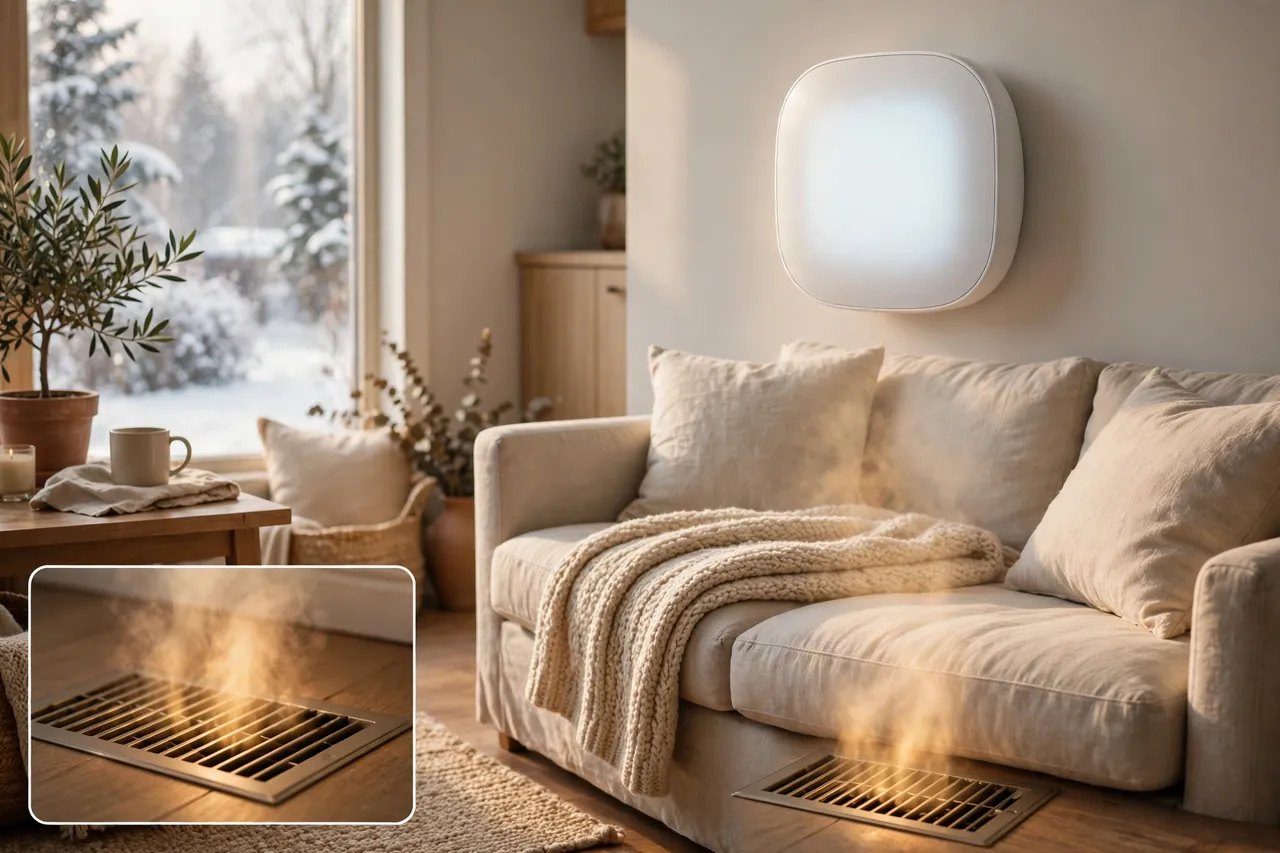
Setbacks work differently with a heat pump because recovery is where the money goes. With a gas furnace, you can drop the temperature 7 to 10 degrees overnight and the furnace blasts the house warm again in the morning. The Department of Energy says that kind of 8-hour setback can save as much as 10% a year on heating and cooling for a typical system. A heat pump cannot do the same trick. When you raise the setting by a big jump, the thermostat calls for aux heat to close the gap fast, and the strips can wipe out every dollar the setback saved.
ENERGY STAR recommends keeping a steady temperature with a heat pump rather than turning it down while you sleep or leave home. The Department of Energy gives the same caution: avoid manual setbacks that cause backup electric resistance heat to come on. The rule for a heat pump is small and slow. NYSERDA recommends avoiding sudden thermostat changes of 3°F or more, because large setbacks can work against heat pump efficiency.
So what should you do at night? Keep the setback small, about 1 to 3 degrees lower than your daytime setting, or hold the temperature steady. If you use a smart thermostat, let it recover gradually. Many heat pump thermostats warm the house 1 degree every 30 minutes, or start heating early so the house reaches your wake-up temperature on time. That feature is often called smart recovery or early start. Turn it on if your thermostat has it. It makes a small setback comfortable without waking the strips.
There is one exception worth knowing. If your backup heat is a gas furnace instead of electric strips, you have a dual-fuel system. A dual-fuel thermostat switches to the furnace below a set outdoor temperature, and the furnace recovers from a setback cheaply. Deep setbacks are safer there. But if your backup is electric strips, treat every big jump as money out the door.
How to Stop Aux Heat From Running Too Often
Aux heat running now and then is normal. Aux heat running all the time is a problem you can usually fix with settings first and a technician second. Start with the cheapest checks, and work your way up.
First, stop making big jumps. Set the temperature you actually want instead of cranking it higher to heat the house faster. If the house is 66°F and you want 70°F, set it to 70°F. Setting it to 75°F will not heat the house faster. It only makes the thermostat call for aux heat sooner.
Second, set an aux heat lockout. A lockout is an outdoor temperature above which the strips are not allowed to run. Many homeowners set it between 30°F and 40°F, and cold-climate heat pumps can push it into the 20s. On an ecobee, you will find it under Settings, then Installation Settings, then Thresholds, as Aux Heat Max Outdoor Temperature. The same menu holds Compressor Min Outdoor Temperature and Heat Pump to Aux Runtime, which sets how long the heat pump tries on its own before the strips join in. Give the compressor more time, and the strips run less.
Third, check your Nest settings if you have one. Google’s Heat Pump Balance controls how readily a Nest thermostat uses aux heat. Max Comfort is the default, and it reaches your temperature fastest even if it means using expensive aux heat. Balanced uses aux heat when needed. Max Savings sets a lower lockout temperature, so aux heat turns on later and less often. If aux heat runs too much, switch Heat Pump Balance to Balanced or Max Savings in the Google Home or Nest app. Note that Heat Pump Balance does not work on dual-fuel systems, so a dual-fuel home needs its own switchover setting instead.
Fourth, check the air filter. A clogged filter cuts airflow, and low airflow makes the heat pump struggle, which calls for aux heat. Carrier notes that aux heat running above roughly 40°F can point to a dirty filter, a refrigerant problem, or another fault. Hold the filter up to the light. If you cannot see through it, replace it.
Finally, watch the pattern. Aux heat on a cold morning or during defrost is normal. Aux heat running for hours on a mild day, or every time the system starts, means something is wrong. Check the filter, check the settings above, and if the pattern continues, call a technician. Our thermostat not working guide walks through the full troubleshooting order before you pick up the phone.
Before You Buy: Heat Pump Thermostat Compatibility Checklist
Not every thermostat works with a heat pump. A standard heating and cooling thermostat does not know how to manage aux heat, balance compressor stages, or handle the reversing valve. Bryant puts it plainly: a heat pump needs a specialized thermostat, because using a non-compatible standard thermostat can make your system blow hot air when you want cool, or permanently lock out your emergency heat. Run through this checklist before you buy any thermostat with a heat pump.
- Look for the words “heat pump compatible” on the box. If the thermostat does not say it supports heat pumps, do not buy it for a heat pump home.
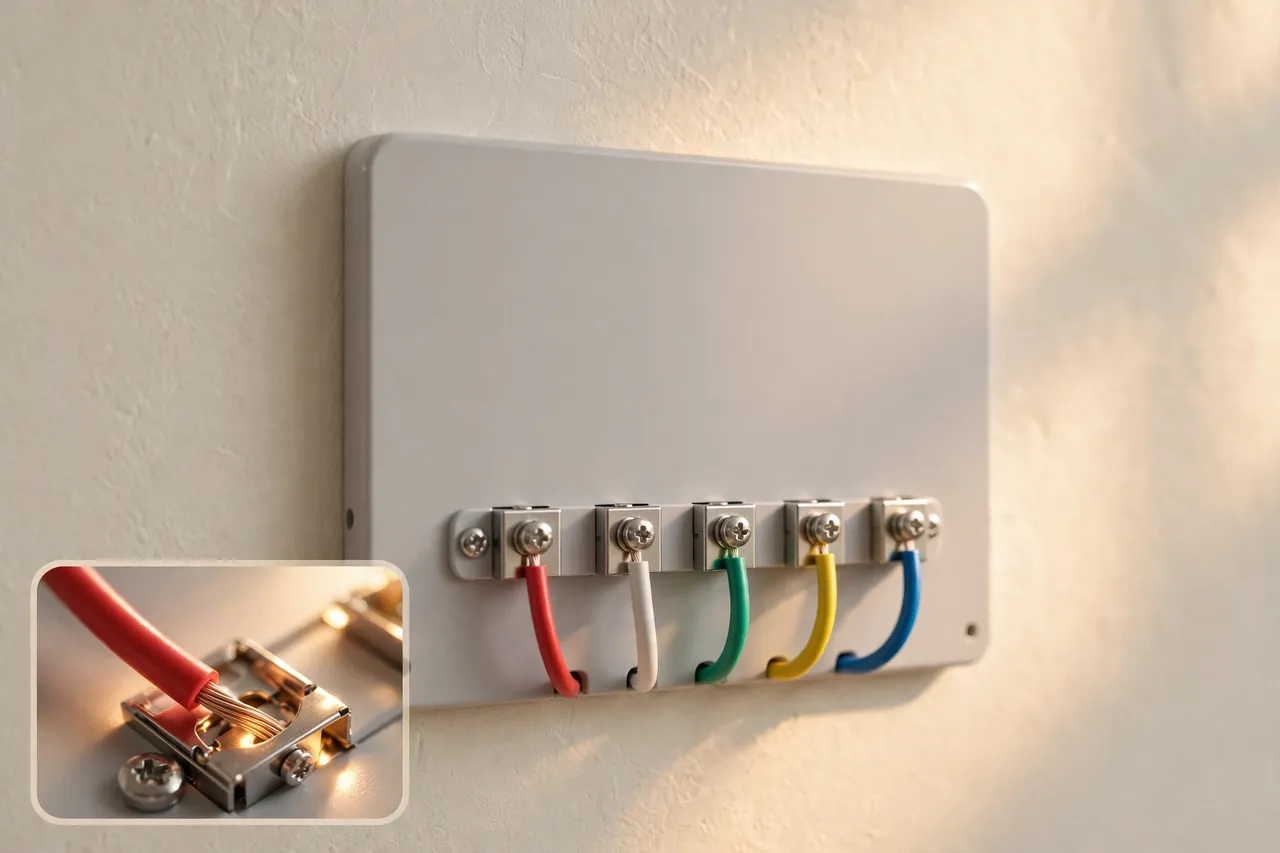
- Check the O/B terminal. Your system needs a thermostat with an O or B terminal for the reversing valve. If your old thermostat has an O or B wire, the new one must have that terminal too, and it must let you set whether O or B energizes in cooling or heating.
- Match the compressor stages. A single-stage heat pump needs one stage of heating and cooling. A two-stage system needs a thermostat that supports two stages. A variable-speed system often needs the manufacturer’s own communicating thermostat to unlock its full efficiency, and a standard smart thermostat may not work at all.
- Count the aux and emergency heat wires. If you have a W2/AUX wire, the thermostat must support aux heat. If you have an E wire, it must support emergency heat. Some budget models support aux heat but have no E terminal, which means you lose manual emergency heat.
- Check the C-wire. Most smart thermostats need a C-wire for steady power. Bryant notes that older systems may need a C-wire added, and many of its smart thermostats include a power extender kit for homes that lack one. Ecobee includes a Power Extender Kit for the same reason. If you have no C-wire, read our guide to the common wire in a thermostat before you order anything.
- Ask about dual fuel. If your backup heat is a gas furnace, the thermostat must support dual-fuel control and a switchover temperature. Not every smart thermostat handles dual fuel well, so confirm it in the specifications, not just on the box.
- Check mini-splits separately. A ductless mini-split often uses its own remote or the manufacturer’s control instead of a standard wall thermostat, and it has no aux heat strips to lock out. Do not buy a standard smart thermostat for a mini-split unless the manufacturer says it works with one.
- Confirm the voltage. Most North American heat pumps use 24-volt control wiring. If your thermostat has thick wires or a label that says 120 or 240 volts, that is a line-voltage system, and it needs a different thermostat and an electrician. If your backup heat runs on electricity alone, our guide to a heat electric thermostat explains how that wiring differs.
When you shop, the best thermostat for a heat pump is the one that matches your system, not the one with the longest feature list. A single-stage heat pump with electric strips works well with most heat-pump-compatible smart models from ecobee, Google Nest, and Honeywell Home. A two-stage or variable-speed system narrows the field fast, and the manufacturer’s own control is often the safest pick. If you are unsure, take your photo of the old wiring and your heat pump’s model number to an HVAC dealer and ask them to confirm the match before you buy.
Smart Thermostat Settings Worth Turning On
A smart thermostat earns its keep on a heat pump when its heat-pump features are actually turned on. The schedule alone is not enough. These are the settings that matter most.
Turn on smart recovery, sometimes called early start or adaptive recovery. It starts heating before your scheduled wake-up time so the house reaches temperature gradually, without calling for aux heat. This one setting makes small setbacks work.
Set your aux heat lockout as described above, or use Heat Pump Balance on a Nest. Either way, the goal is the same: the strips stay off until the heat pump truly cannot keep up.
Use room sensors if your thermostat supports them. Heat pumps deliver cooler air than furnaces, so temperatures change slowly and unevenly. A sensor in the bedroom you actually sleep in gives the thermostat better information than the hallway where it is mounted. Ecobee’s room sensors are the best-known example, and Honeywell Home offers them on models like the T10 Pro.
Be careful with geofencing and away modes. A geofence that drops the temperature by 8 degrees when you leave and races to recover when you come home will trigger aux heat on a heat pump. If you use away detection, keep the away setback small, or let the thermostat recover gradually instead of all at once.
For a broader look at smart models and what they offer beyond heat pumps, read our guide to smart thermostats for the home. And if you want simple phone control without a full Wi-Fi setup, a Bluetooth thermostat can be a useful middle step, as long as it is still heat-pump compatible.
Signs Your Thermostat and Heat Pump Are Not Working Together
A mismatched thermostat does not always fail loudly. Sometimes it just costs you money quietly for months. Watch for these signs.
Your system heats when you ask for cooling, or cools when you ask for heat. That points to the O/B reversing valve setting. Check the setting first, then the wiring. Our thermostat wiring guide covers the exact fix.
Aux heat runs for hours on mild days. Check the filter, check the lockout setting, and check whether someone in the house keeps cranking the temperature up by big jumps. If none of those explain it, the thermostat may be calling for aux heat too early, or the system may have a refrigerant or sizing problem. Both need a technician.
The house never quite reaches the set temperature, or the temperature swings up and down. A thermostat that does not support your system’s stages can short-cycle the compressor or run the wrong stage at the wrong time. A two-stage heat pump on a single-stage thermostat is a classic cause.
The thermostat screen goes blank, reboots, or loses Wi-Fi often. That usually means a power problem, and on a heat pump it often means a missing C-wire. Smart thermostats that steal power through the heating circuit can confuse a heat pump’s control board. Adding a C-wire or a power extender kit usually fixes it for good.
Stop and call a qualified HVAC technician if you see any of these: a burning smell, a tripped breaker that trips again, ice that covers the whole outdoor unit, or a system that runs constantly without heating or cooling at all. Turn the power off at the breaker before you touch any wiring, and never open the outdoor unit or the air handler panel yourself. Low-voltage thermostat wires are safe to photograph and label, but the equipment they connect to is not a DIY job.
Related Guides
Furnace Not Working? Fix It Fast With These Safe Checks First · Heat Electric Thermostat: The Complete Guide to Electric Baseboard Heating Controls · Bluetooth Thermostat: What It Does, How Far It Reaches, and Who Should Buy One
- Thermostat Wiring Guide: Wire Colors, Terminals, Diagrams, and the C-Wire — match every wire by its terminal letter before you swap thermostats.
- Thermostat Not Working — the full troubleshooting order when the system will not respond.
- Smart Thermostats for Home — how smart models compare for a whole home.
- What Is a Common Wire in a Thermostat? — why smart thermostats need a C-wire and what to do without one.
- Heat Electric Thermostat — how electric backup heat wiring works.
- Bluetooth Thermostat — simple phone control for your heating and cooling.
- Em Heat vs Heat — emergency heat explained on its own.
- 3 Ton AC Unit: Cooling Power, Cost and Home Size Explained — how heat pumps fit into whole-home heating and cooling.
- How to Choose a Heating and Air Conditioning System — picking the right system before you pick the thermostat.
Frequently Asked Questions
What temperature should I set my heat pump in winter?
Set your thermostat to 68°F to 70°F for typical winter comfort and leave it there. Avoid large temperature swings, because changes of more than 3 to 4 degrees at once can trigger the backup electric resistance strips. Small, gradual adjustments keep the system in its efficient range.
Should I use emergency heat on my heat pump?
Use emergency heat only if your outdoor unit has physically failed or been damaged. Emergency heat bypasses the heat pump and runs the resistance heating strips alone, which costs much more per hour. Frost on the outdoor unit or slightly cool air during a defrost cycle is normal, and neither is a reason to switch to emergency heat.
Does a heat pump require a special thermostat?
Yes. Heat pumps need a thermostat designed to manage both heating and cooling cycles and auxiliary heat. A standard thermostat cannot control the reversing valve or stage the backup heat correctly, so always buy a model labeled heat pump compatible and match it to your system’s stages.
How do I know if my thermostat is compatible with my heat pump?
Check the system type and wiring labels, or consult your HVAC professional before replacement. Look for an O or B wire for the reversing valve, a W2/AUX wire for backup heat, and an E wire for emergency heat, then confirm the new thermostat supports each one, plus your compressor stages and a C-wire if it is a smart model.
Can I install a smart thermostat on an older heat pump?
In most cases, yes. Older systems may need a C-wire for continuous power, and many smart thermostats include a power extender kit for homes that lack one. Confirm heat pump compatibility and the wiring first, and ask a professional dealer to check the match if anything about your system is unclear.
A thermostat heat pump setup rewards patience more than any other heating system in the house. Keep the temperature steady, change it a degree or two at a time, keep aux heat on a short leash, and buy a thermostat that actually speaks your heat pump’s language. Do those four things and the system stays comfortable, the strips stay quiet, and the bill stays honest.
Disclaimer: This guide covers general home information only. Homes, systems, and local conditions vary. Turn the power off at the breaker before touching any thermostat wiring, and call a qualified HVAC technician for refrigerant, electrical, or control-board work, or whenever you are unsure about your system.